
August 28, 2026
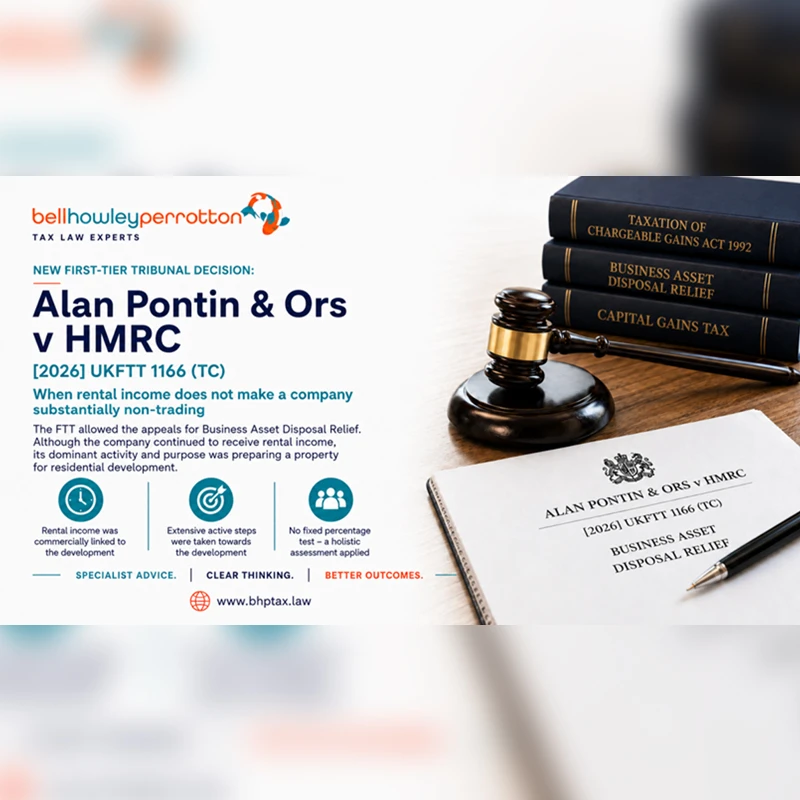
The First-tier Tribunal applies a holistic test to a property company preparing to undertake residential development.

Can a company continue receiving rental income while preparing a property for development and still qualify as a trading company for capital gains tax purposes?
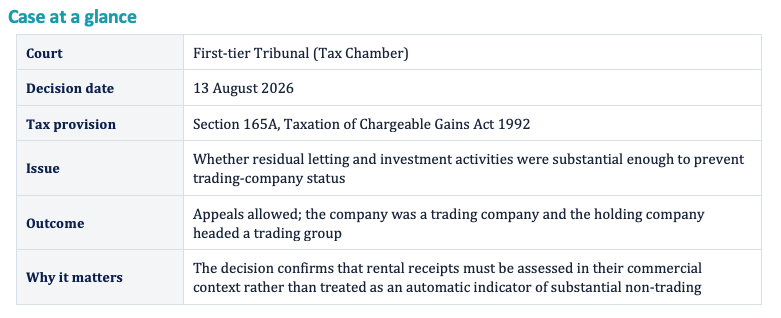
The First-tier Tribunal’s decision in Alan Pontin & Ors v HMRC [2026] UKFTT 1166 (TC) shows that it can.
The decision concerns the former entrepreneurs’ relief, now Business Asset Disposal Relief, but its significance extends beyond the historic claim. It provides a detailed and commercially realistic examination of the statutory requirement that a trading company’s activities must not include, to a substantial extent, activities other than trading activities.
Most importantly, the Tribunal rejected the idea that rental income must automatically be treated as decisive evidence of a substantial investment business. The company’s activities had to be examined in the round and in their proper commercial context.
The four appellants disposed of shares in Highland Holdings Limited following the exercise of an option in April 2016.
Highland Holdings owned Associated Properties UK Limited, which in turn owned a commercial property in Henley-on-Thames. The property continued to produce rental income during the period in which extensive work was being undertaken to secure its residential redevelopment.
Each appellant claimed entrepreneurs’ relief on the disposal of their shares.
For the relief to apply, Highland Holdings had to be the holding company of a trading group throughout the relevant statutory period. That depended upon whether Associated Properties qualified as a trading company.
The statutory issue was therefore not simply whether the company had an intention to undertake development. The question was whether its activities included, to a substantial extent, activities other than trading activities.
HMRC initially disputed whether the company was carrying on any relevant trading activity at all. During the hearing, however, HMRC accepted that the company was undertaking activities with a view to commencing a property-development trade.
The dispute consequently narrowed to whether the company’s continuing rental and investment activities were nevertheless substantial.
Under section 165A of the Taxation of Chargeable Gains Act 1992, a trading company is a company carrying on trading activities whose activities do not include, to a substantial extent, activities other than trading activities.
Trading activities include activities carried on for the purposes of a trade which the company is preparing to carry on.
That is important. A company does not necessarily need to have commenced making sales or carrying out completed development work before it can undertake trading activities. Genuine and sufficiently advanced preparations for a trade can fall within the statutory definition.
The legislation does not, however, define “substantial” by reference to a fixed percentage.
HMRC’s published guidance has historically used indicators based on matters such as income, assets, expenditure and management time. A figure of approximately 20% has often been treated administratively as a useful indicator. It is not a statutory threshold, a safe harbour or an automatic disqualification.
The correct exercise is to identify the trading and non-trading activities and determine whether the non-trading activities were material or of real importance when viewed in the context of the company’s activities as a whole.
The Tribunal applied the approach endorsed in earlier authorities, including Allam v HMRC.
That required a qualitative and quantitative assessment rather than a calculation based upon one isolated factor.
Relevant matters included:
· the nature and purpose of the company’s activities;
· the time and resources devoted to those activities;
· the character and intended use of its assets;
· its income and expenditure;
· the extent of management involvement; and
· the commercial relationship between the rental activity and the proposed development.
No single factor was determinative.
A company may receive all of its current income from rent while devoting the overwhelming substance of its activity, management and commercial purpose to preparing for a future development trade.
Conversely, a company may profess an intention to develop property while continuing in substance to operate an investment business.
The answer depends upon the evidence.
Associated Properties had taken extensive steps towards the residential development of the Henley property.
Those steps went considerably beyond a speculative hope that planning permission might one day be secured. They included sustained involvement in the planning process, work connected with the local neighbourhood plan, engagement with advisers and stakeholders, and the commercial structuring of the proposed disposal and development.
The property had also been reclassified as trading stock in the company’s accounts.
An accounting classification is not conclusive of the tax treatment. Nevertheless, when supported by the company’s conduct, board-level decisions and wider commercial evidence, it may form part of the factual picture.
The Tribunal accepted that a very significant proportion of the directors’ and management’s substantive activity was directed towards achieving the development.
The company was not simply waiting passively for the property to increase in value. It was actively working to create and realise a development opportunity.
The property remained occupied and rental income continued to arise.
HMRC relied heavily upon that fact. It argued that the letting activity was non-trading and sufficiently important to prevent the company from qualifying as a trading company.
The Tribunal did not accept that rental receipts could be considered in isolation from the purpose for which the lettings were retained.
The residual and short-term lettings served several commercial functions. They:
· contributed towards the costs of holding the property;
· reduced exposure to empty-property business rates;
· allowed the property to be used pending redevelopment;
· were structured so as not to obstruct the proposed development; and
· avoided leaving the site visibly vacant during a sensitive planning process.
The existing investment activity was also being wound down rather than expanded.
In that context, the rental arrangements were not evidence that the company had abandoned development in favour of long-term investment. They were part of the commercial management of the property while the development trade was being prepared.
The Tribunal therefore distinguished between the legal form of a letting and its commercial role within the company’s overall activities.
That does not mean rent ceases to be rent. It means that the existence and amount of rental income do not, without more, answer whether the company’s non-trading activities were substantial.
The company’s only meaningful asset was the Henley property.
The critical question was the purpose for which that asset was held during the relevant period.
The Tribunal found that it was held predominantly for redevelopment and ultimate realisation in the course of the intended development activity.
This was supported by the planning work, the treatment of the property as trading stock, the commercial documentation and the directors’ conduct.
The asset could not therefore be characterised merely by observing that it remained physically capable of producing rent.
Its commercial destination mattered.
Standing back and considering all the evidence, the Tribunal concluded that the company’s non-trading activities were not substantial.
The rental activity existed, but it was not material or of real importance when measured against the company’s development activities and commercial purpose as a whole.
Associated Properties was therefore a trading company. Highland Holdings was consequently the holding company of a trading group, and the appellants were entitled to entrepreneurs’ relief.
The appeals were allowed.
The decision does not establish that every company with an intention to develop a rented property is a trading company.
Nor does it mean that rental receipts can simply be ignored where a development is contemplated.
The evidence in Pontin demonstrated sustained, substantive and commercially directed activity. The lettings were managed as a temporary bridge into the intended development and were not part of a continuing strategy to hold the property for long-term investment.
That is materially different from a company which:
· continues to operate conventional long-term lettings;
· undertakes little meaningful development activity;
· has no clear development timetable;
· intends to retain part of the completed site as an investment;
· records the property as an investment asset; or
· relies primarily upon statements of intention made after the event.
The contrast with cases where rental income and continuing investment characteristics were much more significant demonstrates how fact-sensitive this inquiry remains.
Income, asset values, expenditure and management time are relevant, but none provides an automatic answer.
A company with substantial cash receipts from rent may nevertheless be predominantly engaged in preparing a trade. Equally, a company may spend money on planning applications without displacing an investment business.
The complete commercial picture must be assembled.
Not all lettings perform the same function.
Advisers should distinguish between:
· historic investment lettings;
· short-term occupation pending development;
· leases retained to meet property costs;
· arrangements intended to avoid empty rates;
· connected-party occupation;
· lettings which restrict redevelopment; and
· property intended to remain within a long-term investment portfolio.
The character, duration and commercial purpose of each arrangement should be documented contemporaneously.
Board minutes stating that a company intends to develop a property will rarely be sufficient on their own.
The evidential file should include:
· planning applications and correspondence;
· consultant and professional appointments;
· site appraisals and feasibility studies;
· engagement with planning authorities and local stakeholders;
· development timetables;
· financing proposals;
· tenant exit strategies;
· option or sale agreements;
· accounting treatment; and
· records of management time.
In share transactions involving options, conditional contracts or other staged arrangements, the effective disposal date may determine the relevant statutory period.
The company’s status must be tested throughout that period, not merely at completion or when the proceeds are received.
How an asset is being used today is relevant, but so is the commercial purpose for which the company holds it.
A temporarily let development site may be fundamentally different from a property held for income and capital appreciation.
The evidence must show more than an aspiration. It must demonstrate an operational and commercially credible transition from investment to trade.
Pontin is a welcome reminder that the trading-company test is not determined by labels.
Rental income does not automatically make a company substantially non-trading. Nor does the presence of a property asset necessarily mean that the company is carrying on an investment business.
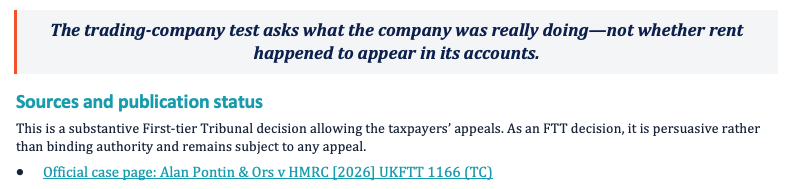
The correct question is broader: what was the company really doing, why was it doing it and how important were the non-trading activities when its business was viewed as a whole?
In Pontin, the evidence showed that the company’s dominant activity and commercial purpose lay in preparing and realising a residential development. The continuing lettings were temporary, commercially explicable and subordinate to that purpose.
That was sufficient for the taxpayers to succeed.









Bell Howley Perrotton LLP is a limited liability partnership registered in England and Wales under number OC353525. Registered office: 20-22 Wenlock Road, London, N1 7GU. VAT number: GB 991703492.
BHP Advisory Ltd is a company registered in England and Wales under number 15240401. Registered office: 53 Davies Street, Mayfair, London, W1K 5JH. VAT number: GB 484722859.
