
August 26, 2026
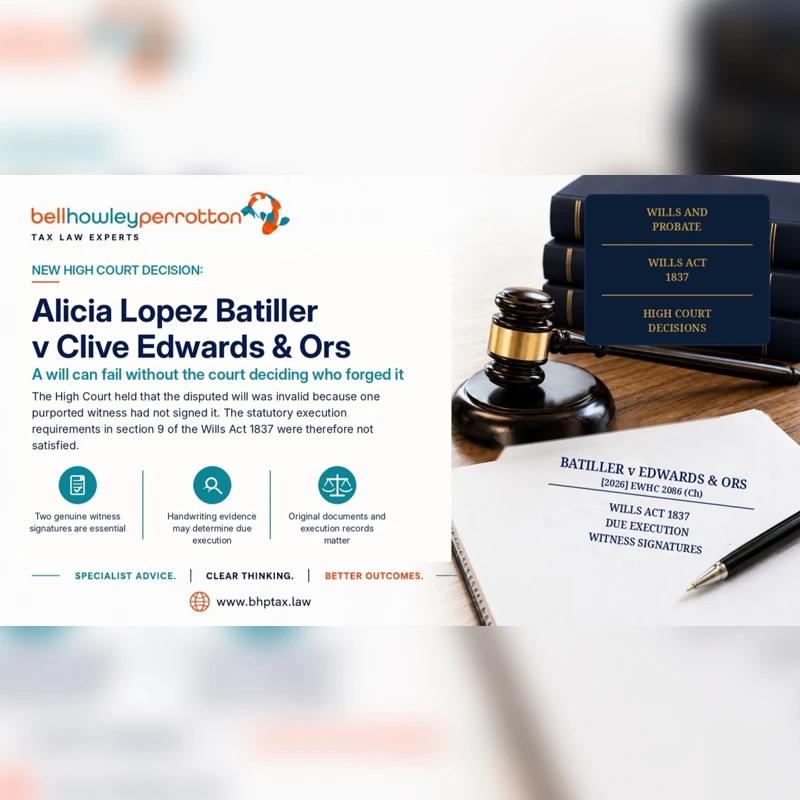
The High Court invalidates a Christmas Eve will because one purported witness did not sign it.

Contentious probate disputes often focus on dramatic allegations: forgery, undue influence, coercion or the testator's mental capacity. Batiller v Edwards is a reminder that the decisive issue may be more fundamental. A document cannot operate as a will unless the statutory execution requirements were actually satisfied.
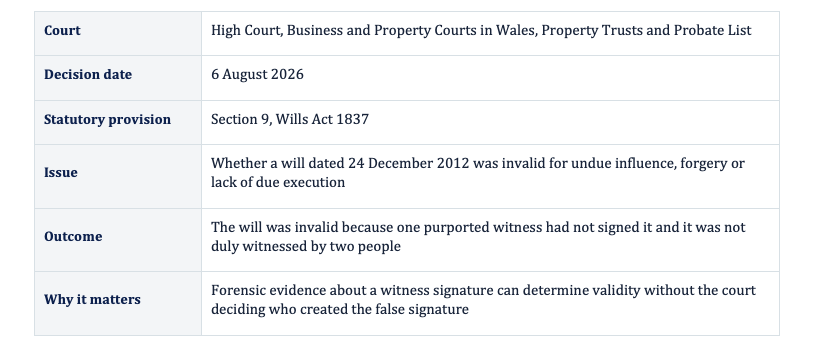
The judgment is short, but its practical significance is considerable. The court did not need to determine every allegation raised by the parties. Once the evidence established that one purported witness had not signed, the will could not satisfy section 9 of the Wills Act 1837.
For practitioners, executors and families, the case highlights the importance of the execution ceremony, the provenance of the original document and the evidence that may be available years later when the people present are no longer alive.
Dorothy May Edwards died in 2017. Her principal asset was Hillcrest Leeswood in Flintshire, the home in which her estranged daughter-in-law, Alicia Lopez Batiller, was living under an occupation order.
Mrs Edwards had made a professionally prepared will on 20 August 2012. That document was not challenged. It divided the residuary estate equally between her daughter, Valerie Beales, and her son, Clive Edwards.
A second document was said to have been executed on Christmas Eve 2012. It left the residuary estate, which was essentially Hillcrest, to Mrs Edwards' grandson Steven Beales. The document appeared to bear Mrs Edwards' signature and the signatures of two witnesses, Lucille Ingram and Stuart Youd.
Probate of the December will was granted in January 2024. The claimant challenged it on three grounds: undue influence, forgery and lack of due execution.
Both people named as witnesses had died in 2020. The only direct account of the alleged signing ceremony came from Clive Edwards, who said that the document was signed at Hillcrest on Christmas Eve. He recalled seeing Lucille Ingram sign, but did not see Stuart Youd sign.
The history of the document was also unusual. Mr Edwards said that his sister initially retained it, that Mr Youd gave it to him a couple of years later, and that he kept it in a safe before hiding it in a gap between wardrobes because he feared the claimant might gain access to it. He said that he delayed seeking probate because he was concerned that the grandson might then want the property sold.
The judge treated Mr Edwards' evidence with caution. In cross-examination he accepted that he had previously edited a passport image and used a false NHS Covid pass to enter licensed premises. That did not itself prove anything about the will, but it was relevant to the weight that could safely be placed on his evidence where there was no corroboration.
Each side instructed a handwriting expert. Their evidence about Mrs Edwards' signature was divided. One expert considered it probable that the signature was not hers and identified similarities with Mr Edwards' handwriting. The other expert maintained that it was written by the same hand as the known signatures.
The evidence concerning Stuart Youd was much clearer. The claimant's expert compared the questioned signature with known examples, including a signature on Mr Youd's own 2015 will. The questioned and known signatures were virtually identical when superimposed. Because naturally written signatures are not exact replicas, the expert concluded that it was highly probable that Mr Youd had not signed the December 2012 will.
No competing expert evidence addressed Mr Youd's signature. The High Court regarded the evidence as strong and persuasive and found, on the balance of probabilities, that he did not sign the document.
Section 9 of the Wills Act 1837 imposes formal requirements for a valid will. Among them, the testator's signature must be made or acknowledged in the presence of two witnesses, and each witness must attest and sign.
Once the court found that Mr Youd had not signed, the result followed. The document had not been witnessed by two people and was invalid.
That conclusion illustrates an important distinction. The court was not deciding merely whether the document looked suspicious or whether the surrounding story was unlikely. It was deciding whether a specific statutory condition had been fulfilled. On the evidence, it had not.
The judgment is especially useful because of what the court did not need to determine. It did not make a final finding on the authenticity of Mrs Edwards' own signature. It did not identify who had created or applied the questioned witness signature. Nor did it determine the allegations of undue influence or the remaining disputes about metadata and the probate documents.
A probate claimant does not always need to prove the most serious allegation in the case. Where one indispensable element of due execution fails, the will is invalid regardless of whether the court can reconstruct exactly how the defective document came into existence.
· Treat execution as a legal process, not an administrative afterthought. The signing ceremony should be supervised carefully and the statutory sequence should be understood by everyone present.
· Record the witnesses' full names, addresses and contact details. Years later, those details may be the only route to evidence of what happened.
· For professionally prepared wills, retain a detailed attendance note recording who was present, who signed, in what order and whether the testator acknowledged an existing signature.
· Preserve the original document and maintain a clear record of custody. Unexplained movement, concealment or late production can create evidential difficulty even where the document was originally genuine.
· Where a will is prepared informally, avoid using interested family members to organise or dominate the execution process. Independent professional involvement can materially reduce the scope for later dispute.
· When instructing handwriting experts, consider every signature that matters. Evidence about an attesting witness may be more decisive than evidence about the testator.
· In litigation, plead alternative grounds carefully. Lack of due execution, forgery, undue influence and want of knowledge and approval are distinct issues with different evidential requirements.
· Do not assume that the death of both witnesses makes a challenge impossible. Documentary, forensic and circumstantial evidence may still enable the court to decide whether the statutory requirements were satisfied.
Batiller does not establish that very similar signatures are always forged, nor that a delayed probate application necessarily proves wrongdoing. The decision depended on the particular expert evidence, the absence of a response on the witness signature and the court's assessment of the factual record.
It also does not mean that every defect in an execution process is fatal. The statutory requirements must be applied to the facts, and some apparent irregularities may not prevent a will from being valid. Here, however, the absence of a second genuine witness signature went to the heart of section 9.
The case is a powerful reminder that testamentary intention and testamentary validity are different questions. A document may contain clear wishes and may present a plausible account of family intentions, but it cannot take effect as a will unless Parliament's execution requirements are met.
For advisers, the best protection is created at the time of signing: independent witnesses, a controlled execution process, a detailed record and secure custody of the original. Once witnesses have died and memories have disappeared, the validity of an estate plan may depend on forensic evidence that no one expected would ever be needed.

This is a substantive High Court judgment in the Property Trusts and Probate List. The court declared the December 2012 will invalid for lack of due execution.
· Official High Court judgment: https://caselaw.nationalarchives.gov.uk/ewhc/ch/2026/2086
· Section 9 of the Wills Act 1837: https://www.legislation.gov.uk/ukpga/Will4and1Vict/7/section/9
This article is general commentary and is not a substitute for legal advice on the validity, execution or challenge of any particular will.









Bell Howley Perrotton LLP is a limited liability partnership registered in England and Wales under number OC353525. Registered office: 20-22 Wenlock Road, London, N1 7GU. VAT number: GB 991703492.
BHP Advisory Ltd is a company registered in England and Wales under number 15240401. Registered office: 53 Davies Street, Mayfair, London, W1K 5JH. VAT number: GB 484722859.
