
August 5, 2026
%20Ltd%20vs%20Revenue%20Scotland.webp)
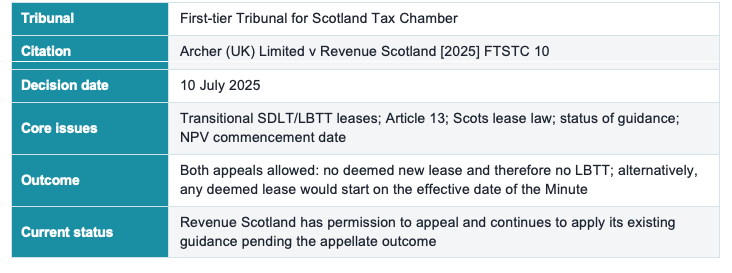
Archer is a useful reminder that guidance can explain a tax charge, but it cannot invent one. The First-tier Tribunal for Scotland held that extending an SDLT-era lease by a Minute of Extension and Variation did not create the deemed new lease asserted by Revenue Scotland. The decision turns on the exact words of Article 13, the differences between Scots and English lease law, and the constitutional point that administrative guidance is not legislation. Revenue Scotland has permission to appeal and continues to operate its existing guidance pending the outcome.
Archer is an important decision because it addresses a temptation that appears regularly in transaction taxes: starting with the result that the tax authority considers Parliament must have intended, and then reading the legislation until it appears to deliver that result. The First-tier Tribunal for Scotland refused to do so.
The tribunal held that the extension of a lease originally granted under SDLT did not create a deemed new lease for LBTT purposes under the transitional provision relied upon by Revenue Scotland. The authority’s published guidance stated that such an extension was taxable. The legislation, properly construed against the background of Scots law, did not.
Archer was the tenant under a Scottish commercial lease executed in 2014, while SDLT still applied to Scottish land transactions. LBTT replaced SDLT in Scotland on 1 April 2015. In 2020, Archer and the landlord executed a Minute of Extension and Variation, completed over several dates between 9 June and 10 July 2020, extending the lease term by five years.
Archer’s then agents initially accepted that the Minute created a deemed new lease under Article 13 of the Land and Buildings Transaction Tax (Transitional Provisions) (Scotland) Order 2014. An LBTT return was filed and £89,738 was paid. Revenue Scotland later calculated the tax on a different basis, treating the five-year deemed lease as beginning only when the original term expired in December 2033. That produced total LBTT of £155,090 and an additional assessment of £65,352 plus interest.
After instructing new advisers, Archer challenged not only the NPV calculation but the more fundamental premise that Article 13 created a new lease at all. It also made an overpayment claim for the £89,738 already paid. The two appeals were heard together.
Article 13 applies to a pre-1 April 2015 lease where, after that date, the lease is varied to increase its term or extend the premises in circumstances which, had the variation occurred before commencement, “would have been for the purposes of” Schedule 17A to the Finance Act 2003 the grant of a new lease.
The wording matters. Article 13 did not say that every post-commencement extension of a pre-implementation lease was automatically a new lease. It required a counterfactual enquiry into how the same variation would have been treated for SDLT purposes before 1 April 2015.
The case exposed an important distinction between English and Scots property law. Under English common law, an agreement extending the term of an existing lease generally operates through a deemed surrender and regrant. In Scots law, the term can be extended by variation without extinguishing the original lease and granting a new one.
Revenue Scotland argued that SDLT practice had aligned Scottish lease extensions with the English treatment and that Article 13 was intended to preserve that tax result after devolution. The tribunal was not persuaded. Neither Schedule 17A nor another express part of the SDLT code deemed this particular Scottish variation to be a new lease. Administrative practice could not substitute for the missing statutory rule.
The Minute would not have been a new lease in Scots law, and the statutory condition in Article 13 was therefore not met. No land transaction arose and no LBTT was due.
Revenue Scotland’s guidance stated that an extension of the term of a pre-implementation lease was treated as the grant of a new lease for LBTT purposes. The tribunal examined both Revenue Scotland and historic HMRC guidance and found that neither identified legal authority for the proposition that extending a Scottish lease had been treated as the grant of a new lease under SDLT.
The legal principle is straightforward but fundamental. Guidance represents the authority’s interpretation of the law. It may be practically important because it signals how returns will be processed and challenged. It cannot impose on a taxpayer a liability or calculation method which the legislation does not impose.
The tribunal also rejected an interpretation based primarily on perceived policy intention. If the Scottish Ministers had intended Article 13 to tax every extension in the same way as an English surrender and regrant, the legislation could have said so. Reading that result into the provision would have crossed the line between interpretation and legislation.
Although it had already concluded that there was no deemed new lease, the tribunal addressed the calculation issue in case that conclusion was wrong. Revenue Scotland treated the five-year term as commencing when the original lease expired in December 2033. Archer argued that any deemed new lease commenced on the effective date of the Minute in July 2020.
The tribunal accepted Archer’s alternative case. If the supposed new lease existed only because the extension was being treated as an English-style surrender and regrant, that regrant would take effect when the variation was executed, not thirteen years later. Revenue Scotland’s approach was also internally inconsistent: it relied on the 2020 effective date for filing and penalty purposes while ignoring it in calculating the NPV.
Accordingly, even on the counterfactual basis that Article 13 applied, the deemed lease would have commenced on the effective date and the £89,738 calculation would have been the relevant one, not £155,090.
Archer succeeded on both issues. The tribunal cancelled the additional assessment and Revenue Scotland’s rejection of the overpayment claim. Its primary conclusion was that the Minute did not create a deemed new lease and that no LBTT charge arose. Its alternative conclusion was that any deemed lease began on the effective date of the Minute.

· Review Scottish variations of leases originally granted before 1 April 2015 by reference to the actual legal effect of the document and Article 13, not guidance alone.
· Distinguish an extension of the existing term under Scots law from a surrender, regrant or genuinely new lease.
· Where tax has already been paid, consider repayment rights and statutory time limits promptly; the existence of an appeal does not suspend those limits.
· Expect Revenue Scotland to continue challenging returns that depart from LBTT6050 until the appellate position is resolved.
· If Article 13 does apply on different facts, analyse the effective date and NPV mechanics independently rather than assuming the extension period begins only after the original term.
The precedent should not be overstated: this is a First-tier Tribunal decision subject to an active appeal. Revenue Scotland confirmed on 4 March 2026 that it had received permission to appeal and expected the appeal to be heard in June 2026. It also stated that it would continue operating in accordance with its existing transitional lease guidance while the appeal remained unresolved.
As at 3 August 2026, the official Revenue Scotland page has not been updated with an appellate decision, and I have not identified a published decision on the official tribunal and court sources checked. The FTT decision should therefore be discussed with that procedural qualification clearly stated.
Archer is a useful counterweight to the idea that a purposive approach permits a tribunal to produce whatever tax result appears most consistent with policy. Purpose informs the interpretation of statutory language. It does not replace that language.
Guidance can explain a charge, administer a charge and warn taxpayers how an authority will approach a charge. It cannot create one. In a devolved system, where transitional provisions sit on top of a distinct body of property law, that distinction is not academic. It can be the difference between no LBTT, £89,738 and £155,090.









Bell Howley Perrotton LLP is a limited liability partnership registered in England and Wales under number OC353525. Registered office: 20-22 Wenlock Road, London, N1 7GU. VAT number: GB 991703492.
BHP Advisory Ltd is a company registered in England and Wales under number 15240401. Registered office: 53 Davies Street, Mayfair, London, W1K 5JH. VAT number: GB 484722859.
