
August 6, 2026
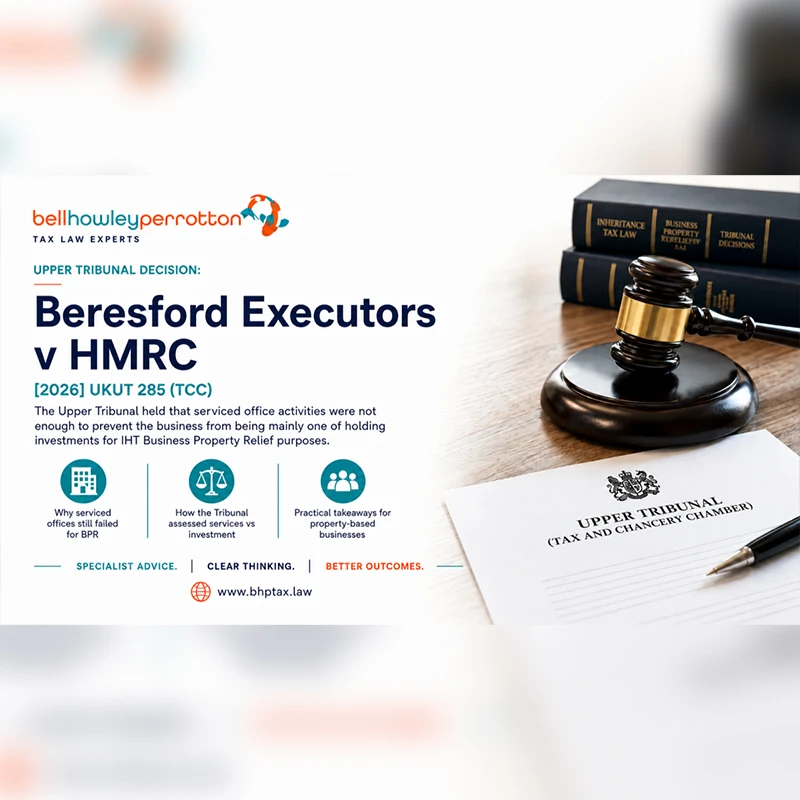
The Upper Tribunal corrected part of the First-tier Tribunal’s reasoning, but still concluded that a serviced-office business was mainly one of holding investments.
The real question is not how many services appear on a list, but what the customer is principally paying for and what gives the business its essential commercial character.
Business Property Relief can remove the value of qualifying business interests from the inheritance tax charge. For unquoted company shares, the relief may be available at 100%. The exclusion in section 105(3) of the Inheritance Tax Act 1984 is therefore critical: relief is denied where the company’s business consists wholly or mainly of dealing in securities, land or buildings, or making or holding investments.
Property-based businesses often operate in the difficult territory between active service provision and investment. Serviced offices, self-storage, serviced accommodation, holiday businesses, marinas and other operational models may involve staff, marketing, customer support and substantial day-to-day activity. Yet activity alone does not determine the statutory character of the business.
Beresford is important because the Upper Tribunal accepted that the First-tier Tribunal had wrongly classified some services, set its decision aside and then reached the same ultimate result after remaking it. That sequence gives the judgment greater analytical value than a simple affirmation of the decision below.
Mr Keith Beresford owned all the shares in Fiveteam Limited, which in turn owned Ninecourt Limited. Ninecourt’s main asset was 16 High Holborn, a six-storey commercial building in London. Two floors were let conventionally for shops and offices. The remaining four floors were operated as serviced offices through Orega Management Limited, acting as Ninecourt’s agent.
The serviced-office proposition was extensive. Clients obtained access to allocated office space and workstations, with flexibility for partitions and office moves. The package included reception services, personalised telephone answering, cleaning, maintenance, office equipment, kitchen and sanitary facilities, heating, electricity and air conditioning. Further services—including meeting rooms, server space, IT, catering, postage, photocopying, secretarial support and couriers—were separately charged.
Income was divided broadly between a facility fee and contract-services fees. The facility fee was the dominant revenue stream and covered both the right to use office space and the standard services. Contract-services fees related to the additional services supplied on demand.
The question under section 105(3) is whether the business consists wholly or mainly of making or holding investments. It is an evaluative judgment rather than a mechanical calculation. Turnover, profit, capital employed, management time, staff activity, the nature of the assets and the customer proposition may all be relevant, but no single factor is decisive in every case.
The authorities require the Tribunal to stand back and look at the business in the round. Active management does not necessarily alter an investment’s essential character. A property owner may advertise intensively, negotiate terms, maintain the building and employ a sizeable team while still carrying on a business that is mainly concerned with exploiting property for income.
Equally, there is no rule that a business involving land must always be an investment business. Services can become sufficiently substantial and commercially central to change the character of the enterprise. The difficulty lies in identifying on which side of that line the particular business falls.
The First-tier Tribunal had treated the provision of heating, electricity and air conditioning as investment-management activities that maintained the building rather than services provided to particular clients. The Upper Tribunal held that this was wrong. Those supplies were component parts of the package for which clients paid and were properly regarded as services.
Because that error might have affected the overall evaluation, the Upper Tribunal set aside the decision and remade it. The taxpayer had therefore established a legal error, but still needed to show that the correctly characterised activities changed the balance.
They did not. The Tribunal concluded that the facility fee remained principally attributable to the grant of flexible rights to use office space. The standard services enhanced that occupation, but did not displace it as the core commercial benefit. The separately charged services were trading activities, yet they were not sufficiently significant to change the essential character of the business as a whole.
The conventional letting of two floors also remained unambiguously investment activity. Taking the operation as a whole, the Upper Tribunal confirmed HMRC’s determination and dismissed the executors’ appeal.
· Do not rely on labels such as “serviced”, “managed” or “operational”. The Tribunal will examine the legal rights granted to customers and the economic substance of what they purchase.
· Separate and quantify service income, direct costs, staff time and profit. A general facility fee can obscure whether services have independent commercial weight.
· Retain customer research, pricing material and internal management information showing why customers choose the business and which elements drive the price.
· Review the business over a meaningful period, not only shortly before a death or transfer. A late attempt to amplify service activity may carry little evidential value.
· Test the counterfactual: if the property occupation element were removed, would a commercially recognisable service business remain?
The judgment does not mean that every serviced-office business fails the BPR test. It does mean that a sophisticated operation, extensive staffing and a long list of services will not automatically convert property exploitation into a non-investment business.
Advisers should also resist treating the BPR analysis as a one-off estate-planning exercise. The factual record is built through contracts, invoices, management accounts, staffing decisions and customer communications. By the time an inheritance tax event occurs, the strongest—or weakest—evidence may already be several years old.
Beresford is a nuanced decision rather than a blunt victory for HMRC. The Upper Tribunal confirmed that genuine services must be recognised as such and should not be dismissed as mere property management. However, the existence of those services did not answer the statutory question.
The decisive issue remained the overall commercial character of the enterprise. Here, the Tribunal considered that the customer was principally purchasing flexible occupation of office space. The services supported and improved that proposition, but did not replace it.
For businesses seeking Business Property Relief, the lesson is clear: the evidential focus should be on the commercial substance, scale and independent significance of the services—not simply their number.









Bell Howley Perrotton LLP is a limited liability partnership registered in England and Wales under number OC353525. Registered office: 20-22 Wenlock Road, London, N1 7GU. VAT number: GB 991703492.
BHP Advisory Ltd is a company registered in England and Wales under number 15240401. Registered office: 53 Davies Street, Mayfair, London, W1K 5JH. VAT number: GB 484722859.
