
August 17, 2026
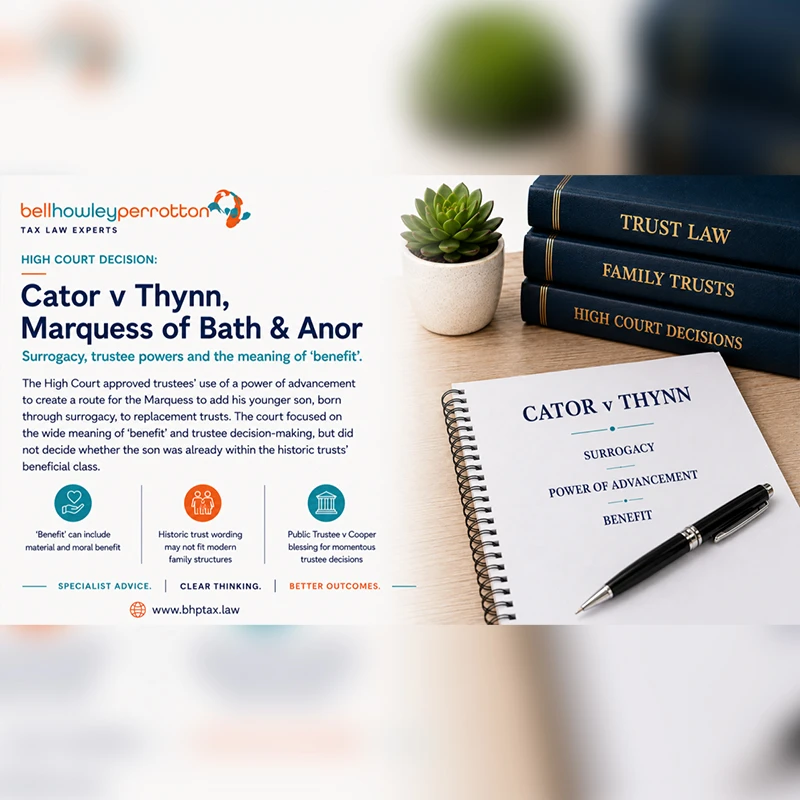
The High Court approved a trustee arrangement designed to address potential inequality between two sons—without deciding whether the younger son, born through surrogacy, was already within the historic trusts’ beneficial class.
The case is not a general ruling that children born through surrogacy automatically fall within every historic trust. Its significance lies in the breadth of “benefit”, proper purpose and the court’s approach to a momentous trustee decision.
Trust deeds are often expected to operate for generations. The difficulty is that the language used when they were drafted may reflect family structures—and legal assumptions—that no longer match modern life.
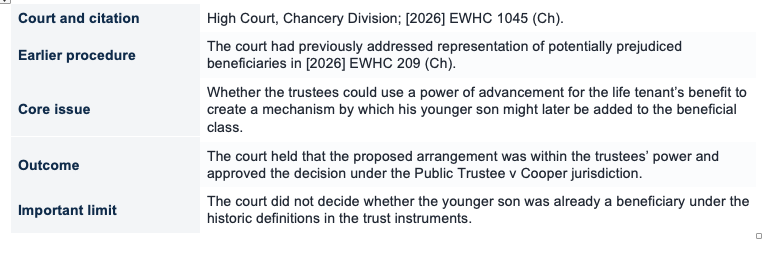
That tension was at the heart of Cator & Ors v Thynn, Marquess of Bath & Anor [2026] EWHC 1045 (Ch).
The case concerned three substantial family trusts connected with the Longleat Estate. Their trustees wished to address a potential inequality between the two sons of the Eighth Marquess of Bath. The elder son was unquestionably within the trusts’ beneficial class. The younger son, although genetically the child of the Marquess and his wife, had been carried by a surrogate in the United States.
The trusts expressly preserved the pre-1970 common-law meanings of expressions such as “child”, “grandchild” and “issue”. This created uncertainty over whether the younger son fell within the relevant class of beneficiaries at all.
The High Court approved the trustees’ proposed solution. However, the case is more nuanced than a simple ruling that a child born through surrogacy must be treated as a beneficiary. The court did not decide that question. Instead, it considered the scope of the trustees’ power of advancement, the meaning of “benefit” in trust law and the circumstances in which a court should bless a momentous trustee decision.
The Marquess was the life tenant of the relevant trust arrangements. The trustees possessed a power to apply trust capital “to or for the benefit of” the life tenant.
They proposed using that power to establish replacement trusts which substantially mirrored the existing arrangements but gave the Marquess a personal power to add his younger son, his descendants and certain related persons to the class of potential beneficiaries.
Importantly, the proposal did not immediately add the son as a beneficiary. It created a power that could be exercised later, once appropriate advice had been obtained about the possible US tax consequences.
Because the proposed exercise could dilute or otherwise prejudice the interests of existing and future beneficiaries, the trustees sought the court’s approval under the jurisdiction commonly associated with Public Trustee v Cooper.
The court therefore had to consider two linked questions:
· Was the proposed arrangement within the scope of the trustees’ power?
· If it was, had the trustees made a decision which the court should approve?
A critical limitation should be made clear.
The younger son was not a party to the proceedings and could not be bound by the outcome. The court was therefore expressly asked not to decide whether he was already included within the trusts’ beneficial class.
HHJ Paul Matthews observed that determining the common-law status of a child genetically related to both intended parents but carried by a surrogate would raise issues which may never previously have been decided in English law.
The court proceeded instead on the assumption that the son was excluded—or that there was at least a sufficiently serious doubt about his inclusion—and considered whether the trustees could lawfully create a mechanism for adding him.
Nor was the court deciding succession to the title of Marquess of Bath. The proceedings concerned the administration of the private family trusts and the trustees’ powers under their governing instruments.
The principal legal issue was whether giving the Marquess a power to add his son could properly be described as an advancement for the Marquess’s benefit.
At first sight, the most obvious beneficiary of the proposal would be the son. He could potentially gain access to substantial family trusts from which he might otherwise be excluded.
But trust law has long recognised that an advancement can benefit the object of a power even where another person receives the immediate financial provision.
For example, making provision for a beneficiary’s spouse or children may benefit that beneficiary by satisfying a moral or financial obligation which the beneficiary would otherwise have to meet personally.
The judge confirmed that “benefit” is construed widely. It is not confined to placing cash or property directly into the beneficiary’s hands. Nor is the arrangement necessarily invalid merely because someone outside the relevant class also benefits incidentally.
The court identified a clear material benefit to the Marquess.
If his younger son remained outside the family trusts, the Marquess might need to make separate provision for him from his own resources. If the son could instead benefit from the trusts, the Marquess’s own resources would be preserved for other purposes.
It did not matter that the Marquess was not shown to be unable to support his son personally. The relevant question was whether his material position would be improved—not whether he lacked the means to make alternative provision.
It also did not matter that any eventual distribution to the son might take place only after the Marquess’s death. Part of the present benefit was the knowledge that his son could be placed within the beneficial class and might receive provision in the future.
The judgment is also important for its treatment of non-financial benefit.
The court accepted that moral considerations can amount to a benefit for the purpose of a power of advancement. That does not mean that every asserted ethical preference or family wish will be sufficient. The concept must still be applied realistically and with common sense.
Here, however, the moral benefit was closely connected with the Marquess’s recognised obligation towards his son.
Both sons were genetically the children of the Marquess and his wife. The difference arose because one had been carried by his mother while the other had been carried by a surrogate. The trustees regarded it as unfair for that distinction to determine whether the younger son could benefit from the family trusts.
The court accepted that enabling the Marquess to place his children on as equal a footing as the dynastic structure allowed was a genuine benefit to him. It could also reduce the risk that avoidable inequality would cause difficulties in the children’s relationship as they grew older.
The case therefore confirms that the concept of benefit may extend beyond immediate financial gain. Emotional security, fulfilment of a recognised family obligation and the reduction of potential family conflict can all be relevant.
But the court also stressed that moral benefit is more difficult to assess than material benefit. The evidence must demonstrate a real and discernible improvement in the position of the object of the power—not merely an abstract proposition that a particular outcome would be morally desirable.
Those representing beneficiaries who might be prejudiced argued that the trustees were not really exercising the power for the Marquess’s benefit.
They suggested that the true purpose was to benefit his son, who was not presently an object of the trusts. If so, the exercise could have been void under the proper-purpose doctrine—historically described as a fraud on a power.
The court rejected that argument.
The very act of enabling the Marquess to add his son was itself both a material and moral benefit to the Marquess. The fact that the son might subsequently receive trust property did not convert the arrangement into an exercise for an unauthorised purpose.
The judge also rejected the suggestion that delaying the addition of the son because of possible US tax consequences indicated an improper purpose. Once the proposed structure was accepted as benefiting the Marquess, there was no reason why that benefit should not be implemented in a tax-efficient manner rather than in a way that created avoidable problems for the existing trusts.
That is an important, although narrow, observation.
Tax efficiency does not by itself establish that a fiduciary power is being exercised improperly. The proper-purpose question remains: what is the power being used to achieve, and is that outcome within the purpose for which the power was conferred?
Having concluded that the trustees possessed the necessary power, the court considered whether their proposed exercise should be approved as a category two Public Trustee v Cooper decision.
In such a case, the trustees do not surrender their discretion to the court. They have already decided what they wish to do and ask the court to confirm that their decision falls within the range of decisions which properly instructed trustees could make.
The court considered whether:
· the trustees had genuinely formed the relevant opinion;
· their opinion was one which a reasonable body of trustees could properly reach;
· they had considered relevant matters and excluded irrelevant ones;
· the decision was rational; and
· the decision was unaffected by any conflict of interest.
The judge accepted that the written evidence about the trustees’ decision-making process could have been fuller. Nevertheless, he was satisfied that the trustees had formed the necessary opinion, that their reasoning was credible and that the proposal was rational, made in good faith and supported by a logical connection between the evidence and the reasons given.
There was no evidence of any conflict of interest. The court therefore approved the proposed exercise of the power of advancement.
The substantive judgment followed an earlier decision in the same proceedings, [2026] EWHC 209 (Ch).
In that earlier judgment, the court appointed a representative defendant to protect the interests of beneficiaries who might be prejudiced by the proposal. This ensured that arguments against the trustees’ position were properly advanced and that the substantive application was genuinely adversarial.
That procedural step reflected concerns arising from Denaxe Ltd v Cooper about the legal basis on which court approval protects fiduciaries from later challenge.
For trustees contemplating a blessing application, the practical lesson is that careful thought must now be given not only to the evidence and the decision-making process, but also to which beneficiaries should be joined or represented so that the court’s determination provides effective protection.
A trust may remain legally effective for many decades while its terminology becomes increasingly disconnected from modern family life.
Definitions of “child”, “issue”, “descendant” and “relative” should be reviewed where a family includes:
· children born through surrogacy;
· donor-conceived children;
· adopted children;
· stepchildren;
· children born outside marriage;
· civil partners and same-sex spouses; or
· family members whose legal status differs between jurisdictions.
Waiting until a death, distribution or succession event may leave the trustees with fewer options and significantly higher costs.
The identity of a child’s legal parents under modern family legislation does not necessarily answer how a much older trust deed defines its beneficial class.
The deed may expressly preserve historic definitions, incorporate concepts of legitimacy or use language whose meaning was fixed when the instrument was executed.
The first step must therefore be careful construction of the particular trust documentation.
A trustee may consider material, emotional, educational, social and moral benefits.
However, an asserted moral benefit must be real, connected to the object of the power and supported by evidence. Trustees should record:
· the obligation or concern being addressed;
· how the proposed exercise improves the beneficiary’s position;
· the direct and indirect beneficiaries;
· why the proposed outcome falls within the purpose of the power; and
· whether less prejudicial alternatives were considered.
The fact that a non-object stands to gain does not necessarily invalidate an exercise of power.
The central question is whether the arrangement, viewed as a whole, genuinely benefits the person for whose benefit the power may lawfully be exercised.
That distinction will often be critical where trustees wish to make provision for a beneficiary’s spouse, child or other dependant.
Even where an arrangement benefits an authorised object, trustees must still consider whether the power is being used for the purpose for which it was conferred.
The documentation should explain why the exercise is an advancement for the authorised beneficiary—not merely a device for transferring value to someone outside the trust.
The trustees deliberately created a power which could be exercised later rather than immediately adding the son, because of potential US tax consequences.
For internationally connected families, trust law, tax residence, citizenship, reporting obligations and succession planning cannot sensibly be considered in isolation.
A legally valid addition to a trust may create adverse tax or reporting consequences in another jurisdiction. The timing and form of any exercise may therefore matter as much as the existence of the power itself.
A Public Trustee v Cooper application is not a substitute for proper trustee deliberation.
The trustees must decide what they consider appropriate, identify the relevant considerations, assess competing interests and document their reasoning. The court reviews that decision; it does not ordinarily make the decision for them.
Cator v Thynn is not a general declaration that every child born through surrogacy is automatically included within every historic family trust.
Its significance is different.
The case demonstrates how trustees may use existing powers to address an outcome produced by language drafted for an earlier social and legal era. It confirms that “benefit” can include both material and moral considerations, and that providing for a beneficiary’s child may itself benefit the beneficiary.
It also reinforces the importance of proper purpose, evidence, rational decision-making and careful court procedure.
The broader message for private client advisers is clear: a trust may be designed to last for generations, but its language should not be assumed to accomodate every way in which future generations may form their families.
Reviewing that language before a difficulty becomes a dispute may be one of the most valuable steps trustees and families can take.









Bell Howley Perrotton LLP is a limited liability partnership registered in England and Wales under number OC353525. Registered office: 20-22 Wenlock Road, London, N1 7GU. VAT number: GB 991703492.
BHP Advisory Ltd is a company registered in England and Wales under number 15240401. Registered office: 53 Davies Street, Mayfair, London, W1K 5JH. VAT number: GB 484722859.
