
August 21, 2026
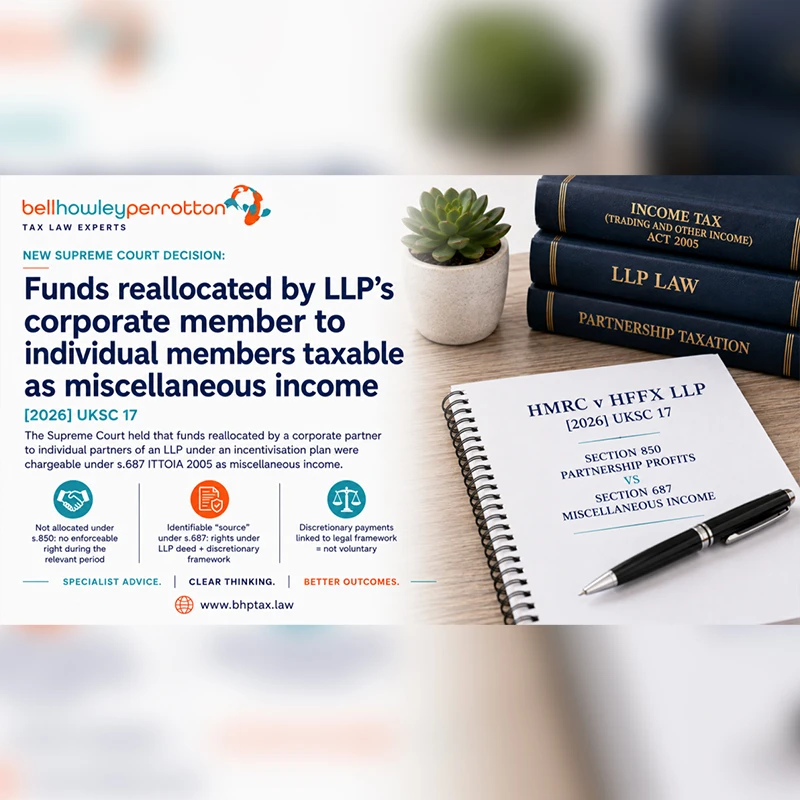
The Supreme Court held that deferred and discretionary amounts allocated first to an LLP’s corporate member were not the individual members’ shares of partnership profits under section 850 ITTOIA 2005—but the later receipts were taxable as miscellaneous income under section 687.
No section 850 allocation did not mean no tax. The Supreme Court identified a different charging route.
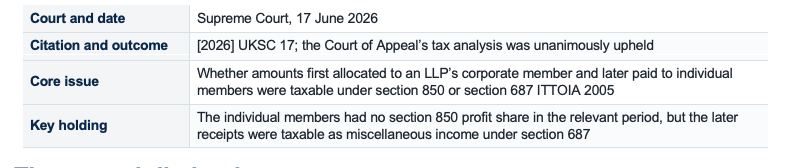
The Supreme Court has confirmed a distinction with significant consequences for LLP remuneration and incentivisation structures: the question whether an amount is an individual member’s share of partnership profits is not the same as the question whether a later payment to that member is taxable income.
In HMRC v HFFX LLP [2026] UKSC 17, the individual members did not have the contractual rights needed for the disputed amounts to be treated as their shares of the LLP’s profits under section 850 of the Income Tax (Trading and Other Income) Act 2005. But that was not the end of the analysis.
The Supreme Court held that the payments later received under the discretionary incentivisation mechanism were chargeable under section 687 as miscellaneous income. The result is a useful warning against treating the failure of one charging provision as proof that a receipt is outside the income tax code altogether.
HFFX operated a profit-sharing arrangement for its individual members. Under the mechanism described in the supplied case report as the CAP, profits were first allocated to HFFX’s corporate member. Funds could later be reallocated to individual members through a discretionary incentivisation process.
The later allocations were not fixed during the relevant accounting period. They were deferred, discretionary and capable of change. Although the CAP had genuine commercial purposes, the individual members had no rights in that period to receive the profits allocated to the corporate member.
That timing mattered. The structure separated the accounting period in which HFFX’s profits were allocated from the later exercise of discretion that produced payments to the individual members.
Section 850 determines how the profits or losses of a partnership are allocated between its members for tax purposes. The Supreme Court held that a member’s share must be identified by reference to contractual rights subsisting during the relevant accounting period.
The purpose of that approach is practical as well as legal. The tax system needs certainty about who is liable for the LLP’s profits for a particular period. Later expectations, later decisions or later payments cannot retrospectively create a profit share that did not arise from rights existing in that period.
Because the individual members had no relevant rights to the amounts while those profits were being allocated to the corporate member, the disputed sums were not their shares of HFFX’s profits under section 850.
The Supreme Court thereby upheld the reasoning reflected in HMRC v BlueCrest Capital Management LP and others [2024] EWCA Civ 1481: section 850 takes its ordinary and natural meaning in context, and the allocation exercise is anchored to rights existing in the relevant period.
The next question was whether the amounts later received by the individual members had another taxable character.
Section 687 charges income that is not otherwise charged. The Supreme Court held that the receipts fell within that provision as miscellaneous income.
The important point is that the Court did not treat the payments as disconnected windfalls merely because they depended on a later exercise of discretion. The founding deed, together with the decisions to make allocations under discretionary powers that attracted Braganza obligations and rights, supplied the necessary legal framework for the payments.
Payments made through that framework were not voluntary in the sense required to place them outside the charge. They had an identifiable source and a sufficient connection to the individual recipients.
The Court’s treatment of “source” is one of the most practically important parts of the decision.
The individual member did not need to “possess” the source in a proprietary or technical sense. The word was given its natural and ordinary meaning in context. What was required was a relevant and sufficient factor connecting the income with the payee.
On the facts, the combination of the LLP’s founding deed and the later decisions under the discretionary mechanism provided that connection. The receipts arose under an established legal and governance framework rather than from detached acts of generosity.
For advisers, this means that the source analysis should not be confined to the final payment instruction. The complete chain of documents and decisions may matter, including the LLP agreement, incentive-plan rules, committee or board decisions and the legal constraints governing the exercise of discretion.
A recurring misconception in incentive arrangements is that a payment cannot be income if the recipient had no enforceable entitlement to it from the outset.
HFFX demonstrates why that is too simplistic. A payment may be discretionary and still arise from an identifiable source. The absence of a fixed right during the profit-allocation period prevented section 850 from applying to the individual members, but it did not sever the later payments from the legal machinery that produced them.
The better analysis is therefore provision-specific. One must ask first whether the amount was a partnership profit share under section 850 and, if it was not, whether the later receipt falls within another charging provision.
The funds allocated to the corporate member had already been taxed at that level. The individual members argued, in effect, that taxing the later payments produced taxation at both stages.
The Supreme Court regarded that feature as irrelevant to the application of section 687. The existence of tax at the corporate-member level did not prevent the later receipts from being taxed in the hands of the individuals where the statutory conditions of the separate charge were met.
That conclusion is commercially important. Perceived duplication is not, by itself, a basis for declining to apply a charging provision. The analysis must follow the legal rights, transactions and receipts at each stage.
The Court’s application of section 687 made it unnecessary to consider Chapter 4 of Part 13 of the Income Tax Act 2007.
This is a reminder that a case does not always need to be resolved through a specialised anti-avoidance code. Where an ordinary charging provision already applies to the receipt, the tax analysis may be complete without reaching a separate anti-avoidance argument.
The decision is particularly relevant to mixed-member LLPs and other structures in which profits are allocated to a corporate member before value is later made available to individuals. It does not mean that every discretionary payment is taxable under section 687, but it does require a disciplined analysis of rights, timing and source.
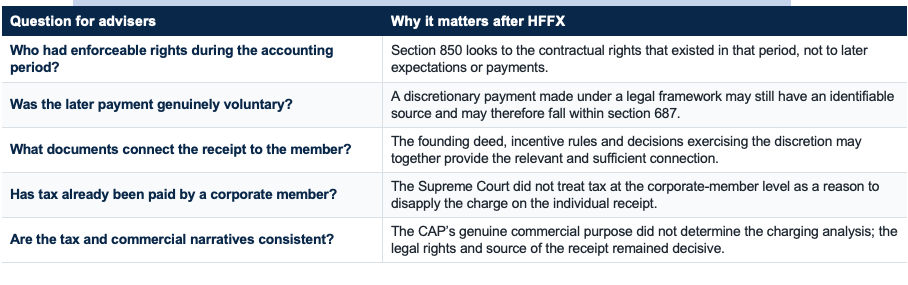
The decisive section 850 question is not who ultimately received value, but what contractual rights each member had during the accounting period in which the LLP’s profits arose. Advisers should record that position contemporaneously rather than reconstructing it after payments are made.
Once an amount falls outside section 850 for an individual, the analysis must continue. The legal nature of the later payment, the circumstances in which it was made and the documents connecting it to the recipient all require separate consideration.
A discretionary decision may still operate within a legal framework that gives the payment an identifiable source. The governing deed and the obligations affecting the decision-maker may be central to that conclusion.
The case report records that the CAP had genuine commercial purposes. That fact did not prevent the later receipts from being taxable. Commercial rationale remains relevant context, but it does not override the statutory analysis of legal rights and income source.
The possibility of tax at both the corporate-member and individual-member levels must be considered when designing or reviewing an incentivisation arrangement. The Supreme Court did not regard the first charge as excluding the second.
· It does not treat the disputed amounts as the individual members’ partnership profit shares under section 850.
· It does not hold that every discretionary payment is automatically miscellaneous income.
· It does not invalidate every arrangement involving an LLP corporate member.
· It does not suggest that genuine commercial purposes are irrelevant; rather, they did not displace the applicable charging provisions on these facts.
· It does not decide the separate Chapter 4 Part 13 issue, because section 687 was sufficient to resolve the tax treatment.
HFFX provides a clear answer to a question that often arises in sophisticated profit-sharing structures: if an amount is not a member’s share of LLP profits, is it necessarily outside the charge to income tax?
The answer is no.
Section 850 required the individual members’ profit shares to be determined by their contractual rights during the relevant accounting period. Because they had no rights to the amounts then allocated to the corporate member, the sums were not their partnership profits.
But the later receipts arose through a legal and discretionary framework that provided an identifiable source and a relevant and sufficient connection to the individual members. Section 687 therefore applied.









Bell Howley Perrotton LLP is a limited liability partnership registered in England and Wales under number OC353525. Registered office: 20-22 Wenlock Road, London, N1 7GU. VAT number: GB 991703492.
BHP Advisory Ltd is a company registered in England and Wales under number 15240401. Registered office: 53 Davies Street, Mayfair, London, W1K 5JH. VAT number: GB 484722859.
