
August 18, 2026

The Upper Tribunal moves the focus from formal documentation to commercial substance.

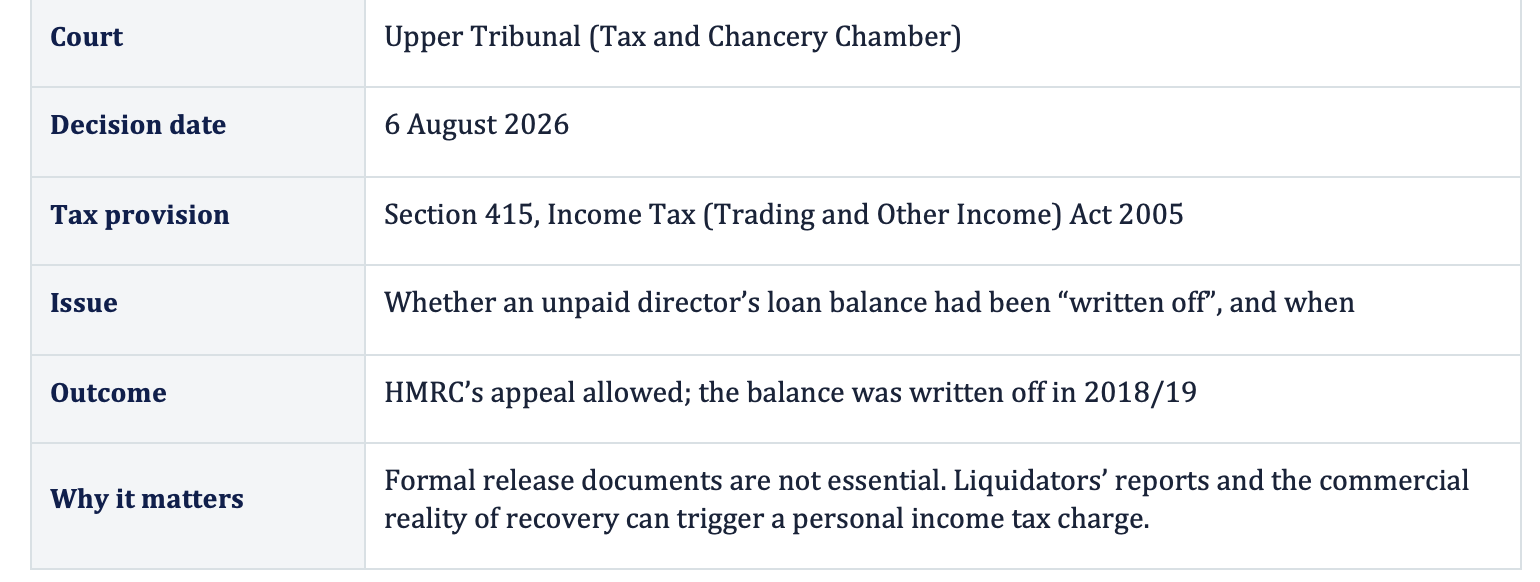
Overdrawn director’s loan accounts are common in owner-managed companies. When the company remains solvent, the tax rules are already complex. When the company enters liquidation, the position becomes more difficult: the company may have no realistic prospect of recovering the balance, yet the debt may continue to exist as a matter of company law.
HMRC v Quillan addresses the point at which that practical abandonment of recovery becomes a “write-off” for income tax purposes. The Upper Tribunal’s answer is important because it rejects the idea that the tax charge depends upon a formal deed, an accounting entry or the liquidator using particular words.
The decision therefore matters not only to directors and shareholders, but also to insolvency practitioners, accountants and advisers reviewing historic liquidations.
Mr Quillan was the sole director of BOH Investments Limited. The company entered creditors’ voluntary liquidation in January 2017, when his director’s loan account was overdrawn by £439,954.
The liquidator demanded repayment. Mr Quillan said that he did not have the means to discharge the full balance and provided information about his financial position. After correspondence and the threat of recovery action, he proposed paying £57,500. Six instalments totalling £57,498 were paid during 2018, leaving £382,456 outstanding.
The liquidator’s final account recorded the sums received and stated that no further funds were expected in respect of the loan account. The company was later dissolved without further recovery.
HMRC assessed Mr Quillan to income tax under section 415 ITTOIA 2005 for 2018/19. The assessment was approximately £145,000 and proceeded on the basis that the remaining balance had been written off.
Section 415 applies where a close company has made a loan or advance to a participator and the whole or part of the debt is later released or written off. The amount released or written off is treated as income of the participator.
The legislation uses two different expressions: “released” and “written off”. A release ordinarily extinguishes the legal obligation. A write-off can be an accounting or commercial recognition that the amount will not be recovered, even if the underlying legal right technically survives.
The distinction proved central. Everyone accepted that no formal release had occurred. The dispute was whether the liquidator’s actions nevertheless amounted to a write-off.
The First-tier Tribunal placed considerable weight on the absence of a formal write-off process and on the liquidator’s later statement that the matter had not been formally written off. It also noted that the company could theoretically be restored and the debt pursued if Mr Quillan later acquired funds.
On that basis, the FTT concluded that the balance had been neither released nor written off. Mr Quillan’s appeal was allowed and the assessment was discharged.
That approach treated the deliberate preservation of the legal debt as strongly indicative that no tax write-off had occurred.
The Upper Tribunal reversed the FTT. It held that the ordinary meaning of “written off” did not require a prescribed legal or accounting procedure. The question was whether, viewed realistically, the creditor had accepted that the amount would not be paid or recovered.
The final account was particularly important. It recorded the limited recovery and stated that no further funds were expected. By that stage the liquidator had completed the recovery exercise and had made a commercial judgment that the remaining balance would not be collected through the liquidation.
The theoretical possibility that the company could be restored did not prevent a write-off. Nor did the continued legal existence of the debt. Those matters might show that there had been no release, but they did not answer the different statutory question of whether the debt had been written off.
The Tribunal therefore held that the outstanding balance was written off in the 2018/19 tax year and that the section 415 charge applied.
The most useful aspect of the judgment is its insistence that the two statutory concepts must be kept separate.
· A release normally involves an act that discharges or compromises the legal obligation.
· A write-off is capable of occurring where the legal obligation remains but the creditor has accepted, for practical and commercial purposes, that recovery will not be made.
· The absence of a deed of release may therefore be decisive on “release” but neutral on “write-off”.
· Evidence created during the liquidation—particularly reports to creditors and final accounts—may carry more weight than a later description of what the liquidator intended.
That distinction prevents the tax result from turning entirely on whether an insolvency practitioner happened to execute a particular document or use a particular accounting label.
The timing of a section 415 charge can be as important as the existence of the charge. HMRC assessed 2018/19, while Mr Quillan argued in the alternative that any relevant event had occurred earlier.
The Upper Tribunal treated the final account as the point at which the liquidator’s position crystallised. It was then that the commercial decision not to expect further recovery was formally recorded. That placed the write-off in 2018/19.
Advisers should therefore identify the specific document or event that evidences abandonment of recovery. A demand, a settlement proposal, the end of instalment payments, the liquidator’s final account and dissolution are not necessarily interchangeable dates.
The judgment also exposes an uncomfortable feature of the legislation. A debt may be treated as written off for income tax purposes even though it remains legally enforceable and the company could theoretically be restored to pursue it.
If recovery later takes place, there is no obvious mirror provision that automatically reverses the earlier income tax charge. The Upper Tribunal drew attention to that apparent mismatch. It is a point that may require legislative clarification or administrative relief, but taxpayers should not assume that a later payment will undo the original charge.
This makes the factual record at the time of liquidation especially important. It also makes it dangerous to treat “write-off” as a harmless accounting description.
· Review the liquidator’s progress reports, final account, creditor reports and correspondence—not only formal releases or the company’s ledger.
· Distinguish clearly between a compromise or release of the legal debt and a commercial write-off for tax purposes.
· Consider the tax year in which the evidence first shows that further recovery was no longer expected.
· Do not assume that keeping the debt technically alive will prevent a section 415 charge.
· Where a company may later be restored or a windfall recovery remains possible, obtain advice on the tax consequences before any further payment or enforcement step.
· Directors should plan for the personal tax cost of a write-off during an insolvency rather than treating it as an issue that arises only on formal dissolution.
Quillan shifts the emphasis decisively towards commercial reality. For section 415, the court is not confined to deeds, board minutes or accounting entries. It can ask what the liquidator had in substance decided and what the contemporaneous documents communicated to creditors.
That produces a more realistic interpretation of “written off”, but it also creates risk. A director may face an income tax charge even though the debt has not legally disappeared and could, at least in theory, be pursued later.
The safest approach is to identify the intended legal and tax treatment of an overdrawn loan before the liquidation is closed—and ensure that the documents accurately reflect that intention.










Bell Howley Perrotton LLP is a limited liability partnership registered in England and Wales under number OC353525. Registered office: 20-22 Wenlock Road, London, N1 7GU. VAT number: GB 991703492.
BHP Advisory Ltd is a company registered in England and Wales under number 15240401. Registered office: 53 Davies Street, Mayfair, London, W1K 5JH. VAT number: GB 484722859.
