
September 1, 2026
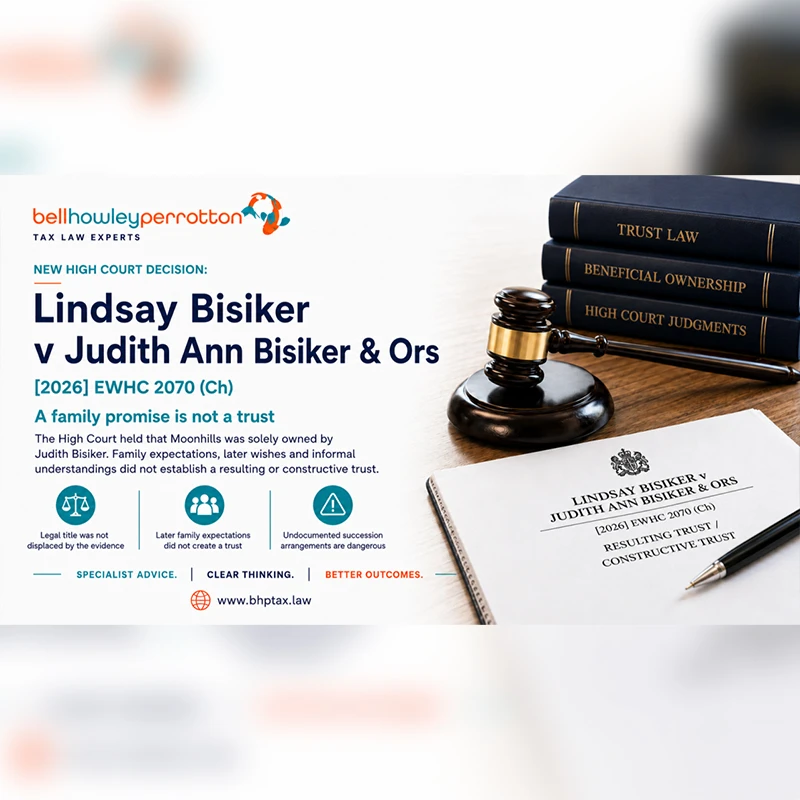
The High Court distinguishes beneficial ownership from family expectations, practical influence and later wishes.

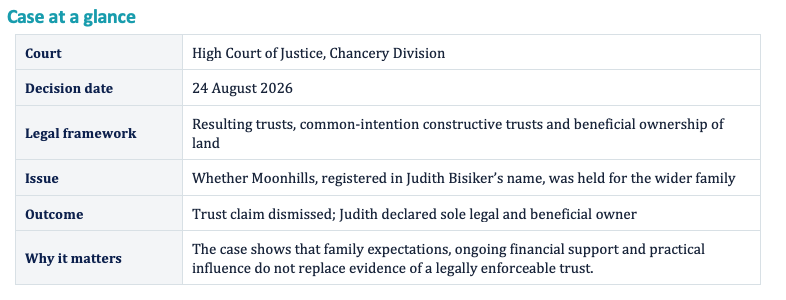
Family property arrangements often begin with trust, informality and shared assumptions.
They become legally difficult when those assumptions change, family relationships deteriorate or an asset acquires a value that nobody anticipated when it was purchased.
Lindsay Bisiker v Judith Ann Bisiker & Ors [2026] EWHC 2070 (Ch) concerned precisely that situation.
A substantial family home had been bought with a father’s money and registered in one daughter’s name. For many years it was used and treated as a wider family base. The father continued to contribute financially and appears to have expected that the property would remain connected with the family.
The High Court nevertheless held that there was no trust.
The daughter in whose name the property had been registered was declared to be its sole legal and beneficial owner.
The dispute concerned a property known as Moonhills in Hampshire.
It was acquired in 1984 with funds provided by Jim Bisiker and registered in the sole name of his daughter, Judith.
Jim also funded extensive improvement works and paid much of the property’s expenditure over many years. Moonhills was used as a family base, and other family members stayed there without conventional tenancy or rental arrangements.
The property subsequently became very valuable.
Lindsay Bisiker, Judith’s half-sister, maintained that Judith did not own Moonhills beneficially for herself. She argued that the property was subject to a trust intended to preserve it for the wider family.
Judith denied that any trust existed and sought a declaration that she was the sole legal and beneficial owner.
Lindsay’s case was advanced through alternative trust-law routes.
One was that the circumstances gave rise to a common-intention constructive trust. On that analysis, the property had been acquired or subsequently held pursuant to a shared understanding that Judith would not enjoy the whole beneficial interest.
The other was that Jim’s payment of the purchase price gave rise to a resulting trust in his favour or for the benefit of a wider family group.
Those arguments depended heavily upon reconstructing what was intended in 1984 and assessing how the property had been treated during the following four decades.
The evidence included:
· the provision of the purchase price by Jim;
· his payment of improvement and running costs;
· family occupation of the property;
· statements said to have been made about keeping Moonhills within the family;
· Jim’s continuing practical influence over the property;
· later documents and statements concerning his wishes; and
· evidence about his capacity when some of the later statements were produced.
The case illustrates the evidential difficulty of attempting to establish an undocumented trust many years after the relevant transaction.
Registration in Judith’s name was not necessarily conclusive of the beneficial ownership.
English trust law recognises that legal and beneficial ownership may be separated. A person registered as proprietor can, in an appropriate case, hold for someone else under an express, resulting or constructive trust.
However, the party alleging the trust must establish the facts from which it arises.
Legal title therefore provided the starting point. Lindsay needed to demonstrate why the beneficial ownership differed from the registered position.
That required evidence of an actual legally relevant intention or of circumstances giving rise to a resulting trust—not merely evidence that Jim remained closely involved with the property or expected Judith to act generously towards her siblings.
The court found no agreement or shared intention in 1984 that Judith would hold Moonhills for the wider family.
Jim was commercially experienced and familiar with trusts and ownership structures. He had access to professional advice and could readily have required a declaration of trust if that was what he intended.
The evidence indicated that a formal trust arrangement had been considered but not adopted.
That was powerful evidence against the later suggestion that an enforceable trust had nevertheless been created informally.
The fact that Jim may have expected Judith to permit family use of the property or share its value voluntarily did not establish that she had agreed to surrender her beneficial ownership.
An expectation of future generosity is not the same as a presently binding trust obligation.
The court also rejected the resulting-trust argument.
Although Jim provided the purchase funds, the evidence supported the conclusion that the acquisition was intended as a gift to Judith.
The family relationship was relevant, but the decision did not rest upon relationship alone. The court considered the complete contemporaneous context, including Jim’s wish to provide Judith with a home, the way in which other children had also received substantial financial support and his decision not to document a retained beneficial interest.
The fact that Jim continued paying expenses and exercising substantial influence did not retrospectively alter the character of the 1984 acquisition.
The court described the position as one in which the house was beneficially Judith’s but remained subject, in practical terms, to considerable influence from her father.
Practical control and beneficial ownership are not necessarily the same thing.
A parent may continue to behave as though a gifted asset remains part of the wider family economy. That does not, without more, recreate an ownership interest that was not retained at the time of the gift.
As the years passed, the property increased considerably in value and family circumstances changed.
Jim appears to have developed or expressed a stronger wish that Moonhills should be divided fairly between his children or remain available as a family asset.
The court distinguished those later wishes from the legally relevant intention when the property was acquired.
A donor may regret the consequences of an earlier gift. They may consider that an arrangement which made sense at the time no longer produces a fair result. They may also expect the recipient to recognise a moral responsibility towards other family members.
None of those matters necessarily changes the beneficial ownership.
A trust cannot ordinarily be imposed retrospectively merely because later events make an outright gift appear unequal or inconvenient.
The question was not what Jim wanted in 2023 or what he might have done had he appreciated the property’s eventual value.
The question was what legal arrangement was created in 1984.
The litigation also illustrates the difficulties arising when elderly family members are asked to confirm historic intentions late in life.
Statements made decades after an event may be affected by:
· fading memory;
· subsequent family discussions;
· changed wishes;
· the influence of interested relatives;
· incomplete knowledge of the original legal advice; and
· questions about capacity.
The court treated the later material with considerable caution.
Even where a later statement genuinely records the maker’s current belief, it does not necessarily provide reliable evidence of what was intended at the time of the original transaction.
That is particularly so where the contemporary documents, professional advice and objective conduct point in a different direction.
The judgment exposes a distinction that frequently causes difficulty in family wealth disputes.
Jim may have expected Judith to treat Moonhills as connected with the entire family.
Judith may have permitted that expectation to continue for many years.
There may also have been a moral argument that some of the value should ultimately be shared.
But trust law does not enforce every moral obligation.
For a legally enforceable trust to exist, the necessary intention and subject matter must be established with sufficient certainty, or the facts must otherwise satisfy the requirements of a recognised constructive or resulting trust.
The language of family loyalty—“this will always be the family home”, “you will look after the others” or “the property should never leave the family”—may express a hope, preference or moral request.
It does not necessarily impose a proprietary obligation.
The court rejected both asserted bases of trust.
It held that:
· there was no agreement or common intention that Judith would hold Moonhills for her siblings;
· Jim’s provision of the purchase price was consistent with an outright gift;
· his later financial contributions did not alter the beneficial ownership;
· subsequent wishes or expectations could not retrospectively create a trust; and
· Judith was the sole legal and beneficial owner.
The trust claim was dismissed.
Where one person provides the purchase funds and another becomes the registered owner, the beneficial position should be documented immediately.
Depending upon the intended arrangement, that may require:
· a declaration of trust;
· a co-ownership agreement;
· a loan agreement;
· a charge or restriction;
· a partnership agreement;
· a letter of gift; or
· properly coordinated will and succession planning.
Silence creates uncertainty.
A family may genuinely believe that everyone understands the arrangement.
Different family members may nevertheless understand it differently.
One person may think an asset has been gifted outright. Another may believe it is being held for the family. A third may regard the registered owner as merely a nominee.
Those differences often remain hidden until death, incapacity, divorce, financial difficulty or a proposed sale.
Allowing relatives to use a property does not necessarily give them a beneficial interest.
Long occupation, payment of some expenses and emotional attachment may be relevant evidence, but they do not automatically create proprietary rights.
The legal basis of occupation should be considered, particularly where a family property is used by several generations.
Funding improvements or running costs after acquisition can create confusion.
The parties should record whether those payments:
· are gifts;
· create a debt;
· purchase a beneficial share;
· are made in return for occupation;
· form part of a family partnership; or
· are simply voluntary contributions.
Without that evidence, later expenditure may support competing narratives without conclusively establishing either.
Where an elderly parent’s succession intentions depend upon an informal understanding, the arrangement should be reviewed while capacity is clear.
That review should distinguish between:
· what the parent currently wishes;
· what legally occurred in the past;
· what rights can now be created;
· what requires the agreement of the registered owner; and
· what can be achieved through the parent’s will or other assets.
A later statement cannot necessarily repair a failure to document the original arrangement.
Property is sometimes placed in a family member’s name for tax, residence, financing or administrative reasons.
Those motives do not themselves determine beneficial ownership.
Indeed, a structure adopted to achieve one legal or tax outcome may produce unintended consequences decades later if the ownership analysis was never recorded.
Advisers should therefore ensure that the intended beneficial position is consistent with:
· the conveyancing documents;
· tax returns;
· mortgage arrangements;
· estate planning;
· accounting records; and
· the parties’ actual conduct.
The case does not establish that every property purchased by a parent in a child’s name is necessarily an outright gift.
Each case depends upon its facts.
A resulting or constructive trust may arise where the evidence supports it. Contemporary documents, contributions, assurances, detrimental reliance and the parties’ conduct can all be relevant.
The central difficulty in Bisiker was that the evidence did not establish the trust that was alleged.
Bisiker is a powerful reminder that family confidence is not a substitute for legal certainty.
A parent can retain considerable practical influence over a property without retaining its beneficial ownership. A child may be expected to act fairly towards siblings without being legally obliged to do so. Later regret or changed succession wishes cannot necessarily reverse an outright gift made decades earlier.
The simplest question should have been answered in 1984: was Moonhills being given to Judith, or was she to hold it for others?
Because that answer was not formally recorded, the family was left to reconstruct it through costly High Court proceedings more than forty years later.









Bell Howley Perrotton LLP is a limited liability partnership registered in England and Wales under number OC353525. Registered office: 20-22 Wenlock Road, London, N1 7GU. VAT number: GB 991703492.
BHP Advisory Ltd is a company registered in England and Wales under number 15240401. Registered office: 53 Davies Street, Mayfair, London, W1K 5JH. VAT number: GB 484722859.
