
August 3, 2026
Mark Gadsden v HMRC [2026] UKFTT 720 (TC)
A First-tier Tribunal decision on historic Class 2 National Insurance contributions, State Pension entitlement and the meaning of “due care and diligence”.

Mark Gadsden’s appeal concerned a problem capable of remaining hidden for decades. He had been self-employed as a barrister since 1981, filed tax returns, paid income tax and paid Class 4 National Insurance contributions. What he had not done was separately register for, or pay, Class 2 contributions for the period from 26 April 1981 to 5 April 2014.
That omission was not merely an historic administrative irregularity. Class 2 contributions were relevant to contributory benefit entitlement, including the State Pension. The gap therefore had a potentially serious and lasting personal consequence.
HMRC accepted that the failure arose from genuine ignorance or error rather than any deliberate attempt to avoid contributions. The decisive question was narrower: had the error occurred despite Mr Gadsden exercising the “due care and diligence” required by regulation 6 of the Social Security (Crediting and Treatment of Contributions, and National Insurance Numbers) Regulations 2001?
The practical difficulty was the distinction between Class 2 and Class 4 National Insurance contributions. Mr Gadsden knew that National Insurance formed part of his annual liabilities because Class 4 contributions appeared in his tax calculations. He did not appreciate that Class 2 was a separate obligation or that paying Class 4 did not, by itself, secure the relevant contributory benefit entitlement.
To a tax professional, the legal and administrative distinction between the two classes may be familiar. To a taxpayer who had consistently declared his profits, paid the liabilities presented to him and engaged accountants to manage his affairs, the assumption that his National Insurance position had been dealt with was not inherently irrational.
The Tribunal approached the issue in that real-world context. The question was not whether, with hindsight, further enquiries could have been made. It was whether the taxpayer’s conduct, judged as a whole and in the circumstances existing at the time, amounted to due care and diligence.
From the beginning of his self-employment, Mr Gadsden used professional accountants to deal with his tax and National Insurance affairs. He understood their role to include the registrations and payment obligations arising from self-employment. He reviewed returns, discussed liabilities and paid what he was advised was due.
This was important. The Tribunal did not treat the case as one in which a taxpayer had simply delegated everything and then disengaged. His reliance on advisers was longstanding, genuine and accompanied by active compliance with the advice and figures provided to him.
The decision therefore draws a useful distinction between responsible reliance and passive abdication. A taxpayer cannot normally answer every failure by saying “my accountant dealt with it”. The evidential question is what the adviser was engaged to do, what the taxpayer reasonably understood, whether the taxpayer supplied the necessary information, and whether there were warning signs that should have prompted further enquiry.
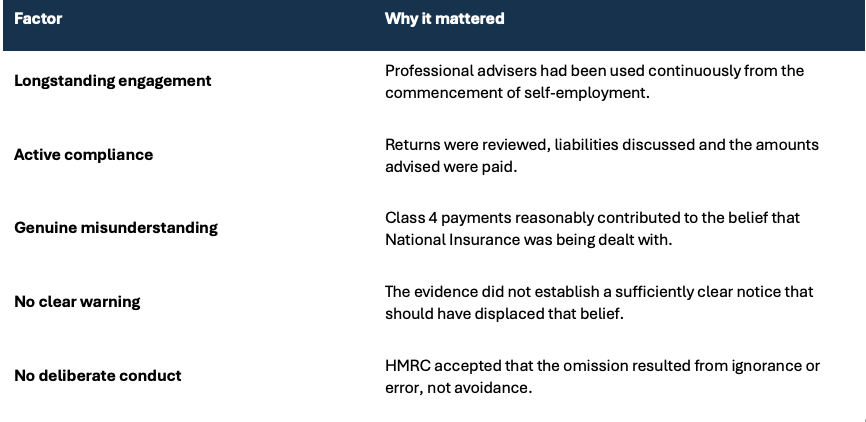
HMRC relied on the possibility that deficiency notices had been issued over the years. That argument faced evidential and substantive difficulties. The evidence did not establish with sufficient clarity that the relevant notices had been sent and received, or that they were materially the same as the examples relied upon.
The Tribunal also considered the nature of the notices. They were not straightforward demands for payment and did not clearly explain that a self-employed person needed to register separately for Class 2 contributions, or spell out the effect of non-payment on State Pension entitlement.
That point has wider significance. A communication may technically contain information without providing a sufficiently clear warning to a reasonable recipient. Where HMRC relies on a notice as the event that should have prompted action, the content, clarity, proof of issue and evidence of receipt may all matter.
The FTT allowed the appeal. It found that the late payment resulted from ignorance or error and that the error was not attributable to a failure by Mr Gadsden to exercise due care and diligence. The relevant late-paid Class 2 contributions therefore had to be treated as paid for contributory benefit purposes.
The result should not be reduced to a general proposition that using an accountant protects a taxpayer from every omission. The judgment was strongly fact-sensitive. It was the combination of sustained professional engagement, the taxpayer’s own conduct, the understandable confusion between contribution classes and the absence of a clear contrary warning that proved decisive.
The case may assist long-term self-employed taxpayers who paid Class 4 contributions but later discovered historic gaps in their Class 2 record. It does not remove the need to prove the statutory conditions. The taxpayer must show both that the failure arose from ignorance or error and that the ignorance or error was not attributable to a lack of due care and diligence.
Evidence is likely to determine the outcome. Engagement letters, historic returns and accounts, correspondence with advisers, payment records, National Insurance notices and evidence of the taxpayer’s understanding may all be relevant. A bare assertion that an accountant was responsible is unlikely to be sufficient.
Taxpayers should also check their National Insurance record before retirement rather than assume that payment of tax and Class 4 contributions necessarily means the record is complete. The earlier a gap is identified, the greater the prospect of resolving it while records and witnesses remain available.
For advisers, the judgment reinforces the importance of defining the scope of an engagement. Where an adviser is expected to deal with self-employment registrations and National Insurance obligations, that should be explicit. Where the work is excluded, the exclusion should be equally clear.
Advice about Class 2 contributions should not be treated as a minor compliance footnote. Historic failures can affect State Pension entitlement many years later, by which point contemporaneous records may be incomplete and the adviser involved may no longer be available.
The case also demonstrates why file notes and clear client communications matter. In a later dispute, the practical question may be not simply what the law required, but what the taxpayer was told, what they reasonably believed and whether anything occurred that should have caused them to question that belief.
Mark Gadsden v HMRC is not a licence for taxpayers to transfer responsibility wholesale to their advisers. Nor does it establish that professional reliance will always amount to due care and diligence.
It does, however, reject an unrealistically absolute view of personal responsibility. Tax administration is complex, and taxpayers are entitled to obtain professional assistance. Where a taxpayer has appointed advisers, remained engaged, supplied information, reviewed returns and paid the liabilities presented to them, that conduct may be entirely consistent with exercising due care.
The most useful principle is therefore a practical one: reasonable reliance is not the same as blind reliance. The quality of the engagement, the taxpayer’s own participation and the clarity of any warnings will determine on which side of that line a case falls.









Bell Howley Perrotton LLP is a limited liability partnership registered in England and Wales under number OC353525. Registered office: 20-22 Wenlock Road, London, N1 7GU. VAT number: GB 991703492.
BHP Advisory Ltd is a company registered in England and Wales under number 15240401. Registered office: 53 Davies Street, Mayfair, London, W1K 5JH. VAT number: GB 484722859.
