
September 3, 2026

The High Court refuses permission under section 115 of the Charities Act 2011 where litigation would not produce sufficient charitable benefit.

Litigation involving a charity is not simply a private dispute conducted against a charitable background.
Where proceedings concern the administration of a charity, the court must consider whether permitting the litigation is genuinely in the charity’s interests.
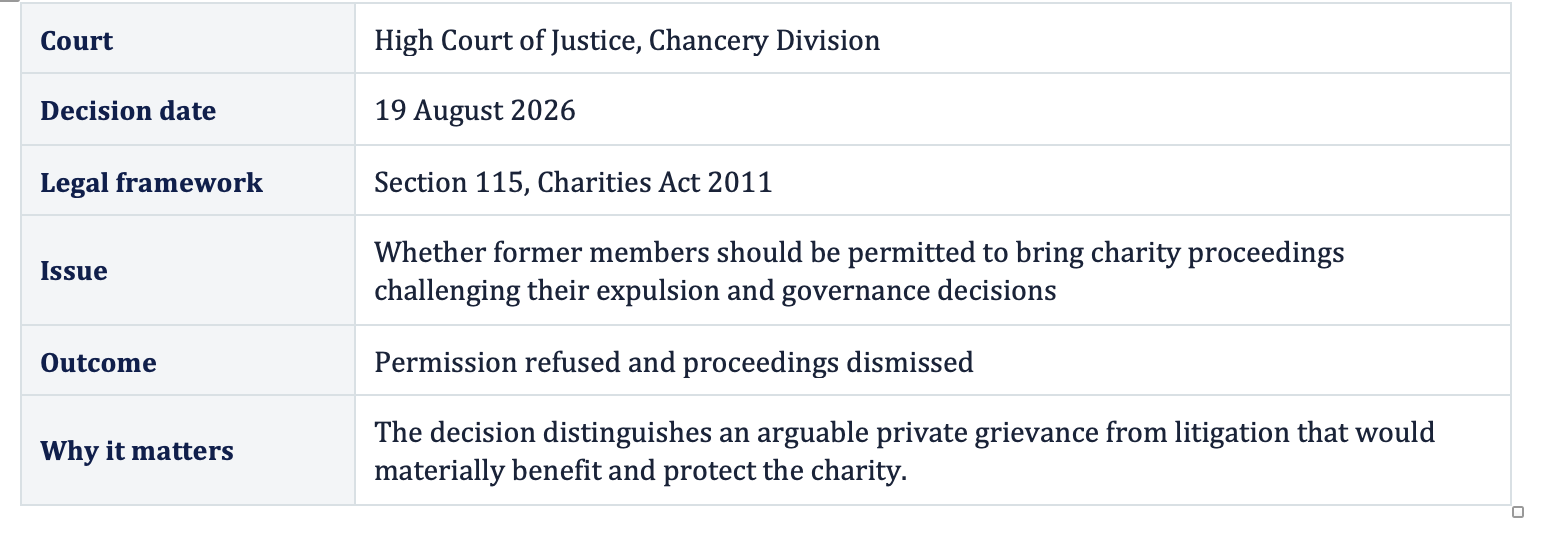
That was the central issue in Mirja Shahriar Ahmed & Anor v Mirja Mohammed Zafar Uddin & Ors [2026] EWHC 2196 (Ch).
The applicants wished to pursue claims arising from an internal dispute within an unincorporated charitable association operating a mosque. The High Court accepted that legally arguable claims might be capable of being pleaded.
Permission was nevertheless refused.
The court’s focus was not limited to whether the applicants might have a case. It was whether allowing the proceedings to continue would produce a sufficient benefit for the charity to justify the financial cost, disruption and risk.
The proceedings arose from a serious breakdown in relationships within the charitable association.
Two former members sought to challenge their expulsion and aspects of the organisation’s governance.
They wished to bring proceedings which fell within the statutory concept of “charity proceedings”.
Before such proceedings can ordinarily be pursued, authorisation must be obtained from the Charity Commission or, where the Commission refuses, permission must be sought from the court.
The Charity Commission had declined to authorise the proposed proceedings.
The applicants therefore asked the High Court to permit them to continue.
Section 115 of the Charities Act 2011 performs an important protective function.
Charitable property is held for public purposes, not for the private interests of trustees, members, donors or officeholders.
Internal litigation can rapidly consume funds which should otherwise be applied towards the charity’s objects. It can also damage governance, discourage donors, divide beneficiaries and prevent trustees from concentrating upon the charity’s work.
The authorisation requirement therefore creates a gateway.
It allows the Charity Commission or the court to consider whether proposed litigation should be allowed to proceed before substantial charitable resources are placed at risk.
This is not a rule that charities must never litigate.
Proceedings may be necessary to:
· recover charitable property;
· restrain a breach of trust;
· remove unsuitable trustees;
· determine genuine constitutional uncertainty;
· protect beneficiaries;
· resolve competing claims to control; or
· obtain directions which permit the charity to function effectively.
But the proposed proceedings must serve the charity.
The applicants maintained that their proposed claims had sufficient legal substance to justify permission.
The court accepted that potentially viable claims could be formulated.
That did not determine the application.
A conventional civil claimant is normally entitled to pursue an arguable claim at their own expense, subject to the procedural rules and the risk of costs.
Charity proceedings are different because the litigation may affect charitable property and a wider class of people who are not parties to the personal dispute.
The court therefore had to look beyond prospects of success.
The relevant considerations included:
· the remedy the applicants realistically sought;
· whether that remedy would improve the charity’s administration;
· the likely cost of the proceedings;
· the charity’s ability to bear those costs;
· the risk of adverse costs;
· the disruption to charitable operations;
· the history and intensity of the dispute;
· the availability of alternative solutions; and
· whether the litigation principally served the applicants’ personal interests.
The existence of an arguable case did not relieve the applicants of the need to demonstrate a tangible charitable benefit.
People involved in charities often invest substantial time, identity and emotion in the organisation.
An expulsion, removal from office or governance decision may consequently feel both personally and morally significant.
The aggrieved person may believe that litigation is necessary to clear their name, correct the record or expose perceived unfairness.
Those objectives may be entirely understandable.
They are not necessarily benefits to the charity.
The court must distinguish between:
· vindication of the individual;
· punishment of perceived opponents;
· restoration of personal status; and
· an outcome which materially improves the charity’s ability to fulfil its purposes.
A claimant cannot satisfy the statutory gateway merely by showing that they believe they were treated wrongly.
They must explain why the proposed relief justifies using, exposing or distracting the charity’s resources.
The court considered the charity’s financial circumstances and the likely burden of continued proceedings.
Litigation of internal governance disputes can become disproportionately expensive. What begins as a challenge to a membership decision may generate:
· disputes over the governing document;
· extensive witness evidence;
· contested elections or meetings;
· allegations about conduct and motive;
· applications for disclosure;
· interim injunctions;
· expert or accounting evidence;
· multiple hearings; and
· substantial costs exposure.
Even if the applicants intend initially to fund their own case, the charity may need to defend the proceedings and may face difficulty recovering its costs.
The possibility of success must therefore be measured against the practical consequences of the litigation itself.
In Ahmed, the court was not satisfied that the proposed benefit justified the cost and risk to the charity.
The history of the disagreement was also relevant.
Long-running internal disputes can become self-perpetuating. Each procedural step generates a new grievance; each meeting or election creates further allegations; and the original charitable purposes become secondary to the contest for control.
By the time the matter reaches court, the parties may view a final judicial determination as the only acceptable outcome.
The court is not required to accept that assessment.
It may conclude that litigation would deepen the division rather than resolve it, particularly where the available remedy would not produce stable governance or restore workable relationships.
The court considered that the dispute had already consumed significant time and resources and that further proceedings were unlikely to deliver a proportionate benefit.
Refusal of permission was described as the least damaging—or “least worst”—course for the charity.
The court concluded that the applicants had not identified a sufficient charitable benefit to justify the proceedings.
Permission under section 115 was refused.
That conclusion did not amount to a final trial of every allegation made by the applicants. Nor did it necessarily mean that every complaint about their treatment was unfounded.
It meant that the proposed litigation should not proceed as charity proceedings because the expected benefit to the charity did not outweigh the cost, disruption and risk.
The proceedings were dismissed, and the applicants faced the costs consequences of the unsuccessful application.
The judgment illustrates three separate questions which should not be confused:
· Does the proposed pleading disclose an arguable legal claim?
· Would the claimant personally benefit from succeeding?
· Would the litigation, viewed as a whole, benefit the charity?
A positive answer to the first two does not necessarily produce a positive answer to the third.
That is the essential discipline imposed by section 115.
Trustees should ask:
· What outcome would the proceedings produce for the charity?
· Would that outcome improve governance?
· Would charitable assets be recovered or protected?
· Would constitutional uncertainty be resolved?
· Would the result enable the charity to function more effectively?
· Is the dispute principally about personal status or reputation?
Those questions should be recorded formally.
A general statement that proceedings are “necessary” is not enough.
Trustees and applicants should consider:
· expected legal costs through each stage;
· exposure to the other side’s costs;
· insurance or funding arrangements;
· the charity’s reserves;
· the impact upon services and beneficiaries;
· management and volunteer time;
· reputational consequences; and
· the likelihood that any costs order will actually be recovered.
A case may identify wrongdoing without providing a useful solution.
Before pursuing proceedings, the parties should be clear about:
· the declaration or order sought;
· how it would be implemented;
· who would govern the charity afterwards;
· whether the parties could work together;
· whether fresh elections or appointments would be required; and
· whether the proposed result would bring finality.
The absence of an effective end-state may weigh heavily against litigation.
An application for authorisation should provide the Commission with a structured explanation of:
· the legal basis of the proposed claim;
· the evidence;
· the charitable benefit;
· costs and funding;
· proportionality;
· alternatives considered; and
· the proposed governance outcome.
If the Commission refuses, the reasons for that refusal should be addressed directly in any application to the court.
Internal charity disputes may be better addressed through:
· mediation;
· an independent chair;
· supervised elections;
· constitutional amendments;
· external governance reviews;
· agreed retirement or appointment arrangements; or
· a scheme or order from the Charity Commission.
These mechanisms may provide practical resolution without consuming the charity’s assets in adversarial proceedings.
Many disputes become more difficult because the charity cannot produce a reliable record of:
· membership;
· appointments;
· removals;
· meeting notices;
· voting;
· resolutions;
· amendments to the governing document; or
· trustee decisions.
Good administration is not merely bureaucratic. It may prevent a disagreement from becoming a dispute about the legitimacy of the entire governing body.
Applicants should not assume that acting out of concern for a charity protects them from costs.
Where permission is refused, the court may order the applicants personally to pay costs.
That risk should be explained before proceedings are issued.
Professional advisers should resist becoming absorbed into the factions within an internal dispute.
Their role is to identify:
· the charity’s legal interests;
· the duties of the existing trustees;
· the status of disputed officeholders;
· the appropriate decision-making process;
· the limits on using charitable funds;
· reporting obligations to the Commission; and
· the route most likely to protect the charity’s purposes.
Advice addressed only to whether a particular faction can win may overlook the more important question of whether the fight should be conducted through charity proceedings at all.
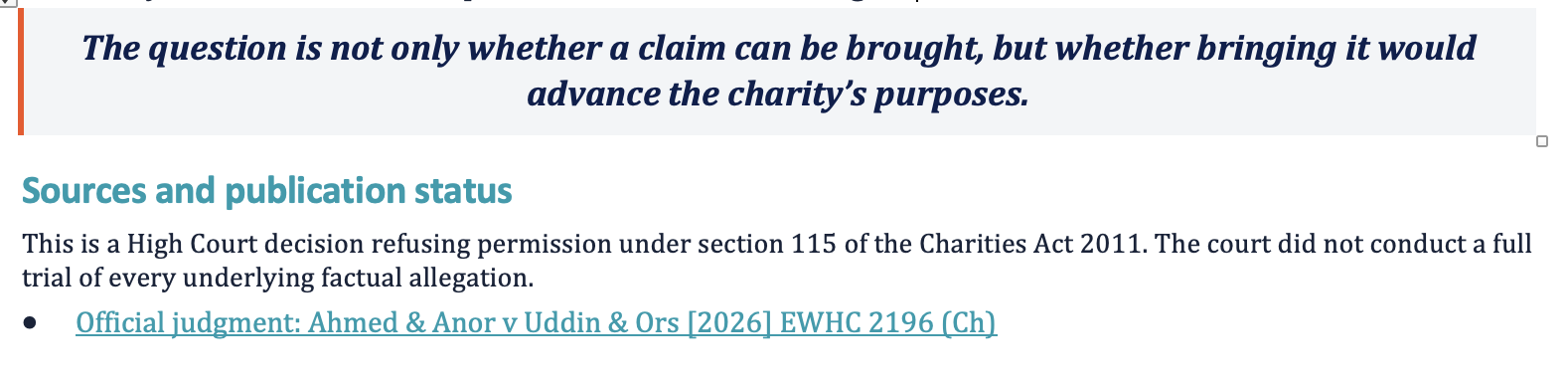
The decision was concerned with permission to bring charity proceedings.
It was not a full trial of every underlying factual and governance allegation.
The refusal of permission should therefore not be presented as a finding that the applicants had no conceivable complaint.
The court’s conclusion was narrower and more practical: whatever the arguability of the proposed claims, pursuing them was not shown to provide sufficient benefit to the charity.
Ahmed v Uddin reinforces an important principle.
A charity is not a vehicle through which individuals may litigate every internal grievance. Its assets, reputation and management time must remain directed towards its charitable purposes.
An arguable legal case may be necessary for permission under section 115, but it is not sufficient.
The decisive question is whether the litigation will leave the charity better protected, better governed or better able to fulfil its purposes.
Where the answer is uncertain—and the cost, disruption and personal nature of the dispute are clear—the court may conclude that the responsible course is not to litigate.









Bell Howley Perrotton LLP is a limited liability partnership registered in England and Wales under number OC353525. Registered office: 20-22 Wenlock Road, London, N1 7GU. VAT number: GB 991703492.
BHP Advisory Ltd is a company registered in England and Wales under number 15240401. Registered office: 53 Davies Street, Mayfair, London, W1K 5JH. VAT number: GB 484722859.
