
August 3, 2026
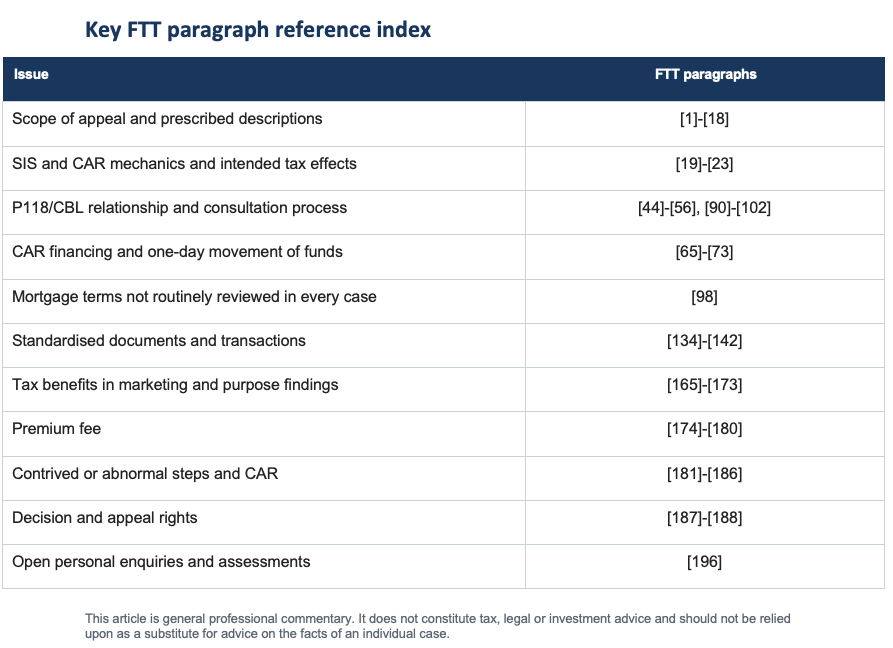
What the First-tier Tribunal decided, what it did not decide, and why the unresolved legacy for clients matters
THE BOTTOM LINE
Property 118 and Cotswold Barristers won their DOTAS appeal. They did not obtain a ruling that SIS or CAR works. Paragraph [196] records that most user witnesses remained under HMRC investigation or assessment and understood the DOTAS proceedings to be separate from their personal tax disputes. The judgment did not determine those liabilities.
References in square brackets are to the numbered paragraphs of Property 118 Limited & Cotswold Barristers Limited v HMRC [2026] UKFTT 01111 (TC).
Property 118 won its DOTAS appeal. It did not win a ruling that the planning works.
Those propositions are both true, and the distinction between them is the central point of this judgment. It is not semantic. It is the difference between deciding whether arrangements had to be notified under a statutory information regime and deciding whether an individual taxpayer is liable for Capital Gains Tax, Stamp Duty Land Tax, interest, penalties or contractual consequences.
The First-tier Tribunal allowed the appeals and cancelled the Scheme Reference Numbers because the precise requirements of the three DOTAS descriptions relied upon by HMRC were not all satisfied (FTT [7], [187]). That is a genuine and significant success for the appellants. But the FTT did not determine the substantive effectiveness of the arrangements or the personal tax liabilities of users who remained under investigation or assessment. Paragraph [196] records the witnesses’ understanding that the DOTAS proceedings were separate from those disputes.
Most of the individual witnesses remained subject to an HMRC investigation and/or assessment. Paragraph [196] records their evidence that they understood the DOTAS proceedings to be separate from their personal tax disputes. That was a record of their understanding, rather than a separate judicial determination that no aspect of the judgment could ever be relevant in later proceedings.
The evidential context is also important. At [261], the Tribunal found that P118’s process of seeking witnesses and assisting with their statements had fallen short of best practice and that witnesses appeared to have been encouraged to emphasise the commercial benefits of the arrangements. At [262], it therefore adopted a particularly careful approach to assessing each witness’s evidence.
Following cross-examination and individual evaluation, the Tribunal nevertheless found the witnesses overall to be honest and credible, while noting that a few were inconsistent, lacked full understanding or were mistaken about some consequences of incorporation.
The judgment did not determine any individual user’s substantive tax liability. Particular findings concerning purpose or commerciality may be relied upon as potentially relevant in later proceedings, but they are not binding determinations of those liabilities. Their relevance and weight will depend upon the facts, evidence and legal issues in each individual case.In my view, any suggestion that the judgment has "vindicated" the SIS or CAR planning as a whole goes materially beyond what the Tribunal decided. The decision deserves accurate recognition, but it cannot be used as a judicial clean bill of health for questions that were never before the FTT.
The Tribunal stated the dispute in direct terms: whether the substantial incorporation structure ("SIS") and the capital account restructure ("CAR") were "notifiable arrangements" for the purposes of DOTAS (FTT [4]).
HMRC relied on three prescribed descriptions under the Tax Avoidance Schemes (Prescribed Descriptions of Arrangements) Regulations 2006:
1. Description 5 - standardised tax products, in relation to SIS and CAR;
2. Description 3 - premium fees, in relation to CAR; and
3. Description 9 - financial products involving contrived or abnormal steps, again in relation to CAR (FTT [7], [10]-[18]).
DOTAS is an information and disclosure regime. Its statutory descriptions are prescriptive. The fact that arrangements are tax-driven, standardised, widely promoted or expected to produce a tax advantage does not automatically make them notifiable. Every condition of the particular description must be satisfied.
The FTT answered that statutory question in the appellants' favour. It did not conduct a general trial of whether the transfers, trusts, partnerships, director loan accounts, relief claims or mortgage arrangements worked.
SIS was implemented through a suite of four documents executed on the same day: a sale and purchase of partnership agreement, a declaration of trust, an agency agreement and a property sale contract. In broad terms, beneficial ownership of the property business was intended to move to a company while registered legal title and the existing mortgages remained with the original owners until a later transfer (FTT [20], [23]).
CAR added a facility agreement and a short-term financing sequence. A bridging lender purportedly lent money to the users; the users lent the corresponding amount to the company; and the company repaid the bridging lender. The company was then left owing the users the corresponding director loan balance, from which future repayments could be made without income tax or National Insurance contributions (FTT [21]).
The Tribunal recorded that users may obtain a number of tax effects, including mitigation of section 24, taxation of retained profits at corporation tax rates, possible incorporation relief under section 162 TCGA 1992, the so-called "washing out" of accrued property gains from the company's base cost, and the CAR director loan benefit (FTT [22]). The conditional language is important: the paragraph describes possible or intended outcomes. It does not decide that any individual user qualified for them.
The commercial rationale advanced for SIS was that transferring only beneficial ownership avoided an immediate refinancing and the need to involve lenders, preserving existing finance and flexibility while seeking to protect incorporation relief (FTT [23]). The Tribunal later found that avoiding refinancing for the non-tax reasons identified was one of the two main reasons for using SIS (FTT [155], [160], [166]).
It would be wrong to minimise the result. On the descriptions HMRC selected, the FTT held that SIS and CAR were not notifiable. Unless altered on appeal, that is the legal answer to the DOTAS issue.
It would be equally wrong to describe the judgment as a rejection of HMRC's concerns across the board. HMRC established a great deal:
· P118 accepted that it was a promoter in relation to CAR, and accepted the relevant promoter requirement for description 5 (FTT [13]).
· The implementation documents were highly standardised, their operative provisions required no material tailoring, and users executed the same four or five transaction documents with their details inserted (FTT [134]-[136]).
· P118 and CBL determined the essential structure and shape of the CAR documents, including the short-term bridge intended to be repaid within a day (FTT [139]).
· Implementation required users to enter into the specific transaction sequence represented by those documents (FTT [141]-[142]).
· The marketing materials presented section 24 mitigation and incorporation relief as important and key attractions (FTT [165]).
· Obtaining incorporation relief and avoiding section 24 were main purposes of SIS, although not the single main purpose required by description 5 (FTT [166]).
· The CAR tax benefit and CAR incorporation-relief benefit were main purposes of CAR, although not the single main purpose of the arrangements as a whole (FTT [172]).
· At least some of the expected tax advantages were main benefits of the arrangements for the general DOTAS test (FTT [186]).
This is not a judgment that the arrangements were bespoke, non-tax-motivated or outside the promoter framework. The appellants won because the exact wording of each hallmark was not fully satisfied.
HMRC succeeded on the standardisation elements but failed on the final purpose condition. Description 5 required the informed observer to conclude that obtaining a tax advantage was the main purpose of the arrangements, or that they would be unlikely to be entered into but for the expectation of a tax advantage.
The FTT accepted that tax outcomes were prominent and that incorporation relief and section 24 mitigation were main purposes. It nevertheless accepted that users could also have substantial commercial reasons for incorporating and for delaying legal-title transfer and refinancing. Those other reasons meant that no tax purpose was the single most important purpose of SIS or CAR (FTT [149]-[173]).
That distinction is not a loophole invented by the Tribunal; it is the wording of the hallmark. On the FTT's analysis, the difference between "a main purpose" and "the main purpose" was decisive.
The 1% bridging fee and P118's 1% brokerage fee related to the CAR financing. The FTT held that they were commercial charges for providing and arranging finance, rather than fees significantly attributable to the tax advantage. There was no other evidence that a promoter of similar arrangements could command a premium fee (FTT [21], [174], [179]-[180]).
The FTT accepted that CAR included a specified financial product and rejected P118's contention that the expected tax advantages were not main benefits. CAR nevertheless escaped description 9 because the Tribunal held that the bridging and director loan steps were not contrived or abnormal (FTT [18], [181]-[186]).
That is the part of the judgment which, in my view, merits the closest scrutiny.
The evidence recorded at FTT [70] was striking. The money movements ordinarily took place within one day. The funds moved through different client accounts operated by Fab Lets. The bridging lender and Fab Lets were controlled by the same individual. The funds remained under that operator's control, and P118 acted as broker or packager for the unregulated business finance. An advice letter described the paperwork as showing that users had "technically" lent the bridging cash to their companies.
In practical terms, the money circulated within a day through accounts controlled by Fab Lets, and the net result was that NewCo owed the users money on a director loan account. HMRC emphasised that the proceeds were at no stage under the control of either the users or NewCo (FTT [70], [182]).
HMRC submitted that, when the user and company were viewed together, they were in exactly the same position after CAR as before it. All that was achieved was the creation of a liability owed by NewCo to the user, giving rise to the claimed tax advantage; unlike conventional bridging finance, the Bridging Loan and NewCo Loan served no meaningful commercial function (FTT [182]).
The Tribunal defined a contrived or abnormal step as one which is artificially structured, lacks a commercial or economic purpose, or differs from what is usual or ordinarily expected (FTT [183]). It also recognised that a direct conversion of the capital account into a director loan would have produced the same access to loan repayments, but would have generated an immediate CGT consequence; CAR was intended to avoid that consequence (FTT [184]-[185]).
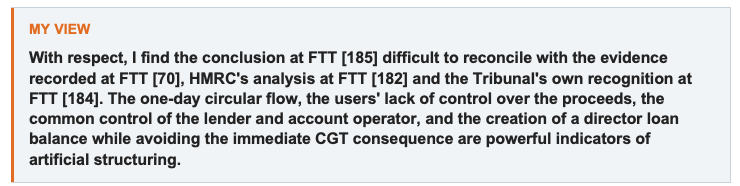
Circularity is not automatically fatal. A short-lived loan can create real legal obligations, and funds need not pass into a borrower's ordinary bank account before a valid financing exists. The FTT was entitled to apply the specific language of description 9, and its conclusion stands unless successfully appealed.
But the judgment should not be transformed into a wider finding that CAR must be respected for all tax purposes. The FTT was not deciding the Ramsay analysis, the substantive section 162 computation, the validity of the director loan balance, or whether the transaction documents achieved the legal and accounting result claimed in an individual case. A finding that the steps were not contrived or abnormal for one DOTAS hallmark is not the same as a finding that the tax planning works.
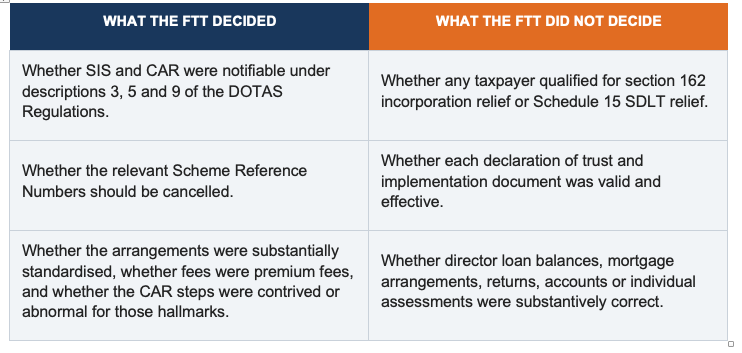
The FTT did not determine whether any individual taxpayer:
· carried on a qualifying business for section 162 TCGA 1992;
· transferred that business as a going concern together with the whole of the required assets;
· received consideration satisfying the incorporation-relief conditions;
· was genuinely carrying on the property business in partnership;
· qualified for SDLT partnership relief under Schedule 15 FA 2003;
· validly executed each declaration of trust and transferred beneficial ownership;
· created a legally and tax-effective director loan balance under CAR;
· correctly accounted for the transactions in the company and personal tax returns;
· complied with the terms of each mortgage, insurance policy and related contract; or
· remained liable under an HMRC enquiry or assessment.
The wording at FTT [19] and [22] is careful: partnership relief and incorporation relief "may" be available. Those paragraphs explain the possible tax effects needed for the DOTAS analysis; they are not findings of individual entitlement.
Paragraph [196] records that most user witnesses were subject to an HMRC investigation and/or assessment, that most of those investigations remained open, and that the witnesses who were asked understood the DOTAS proceedings to be separate from their personal tax disputes. It also records their understanding that the outcome would have no bearing on those personal issues. That is a record of their evidence and understanding, rather than a separate judicial determination of the possible relevance of particular findings in later proceedings.
The judgment did not determine any individual user’s substantive tax liability. Particular findings may be advanced as relevant in later proceedings, but their relevance and weight will depend upon the facts, evidence and legal issues in each individual case. It remains incorrect to present the judgment as having generally cleared SIS or CAR.
The evidential context is also important. At [261], the Tribunal found that P118’s process of seeking witnesses and assisting with their statements had fallen short of best practice and that witnesses appeared to have been encouraged to emphasise the commercial benefits of the arrangements. At [262], it therefore adopted a particularly careful approach to assessing each witness’s evidence. Following cross-examination and individual evaluation, the Tribunal nevertheless found the witnesses overall to be honest and credible
SIS was designed to leave legal title and the registered charge in the users' names while beneficial ownership was said to move to the company. That may preserve the lender's registered security. It does not, by itself, establish compliance with the borrower's contractual covenants.
At [151], for the limited purpose of the DOTAS comparator, the FTT found that SIS could enable full incorporation relief that might not be available following a refinancing. It did not determine entitlement to relief in any individual implementation.
The evidence recorded at FTT [98] was that mortgage terms were considered "where necessary", but were not routinely considered in respect of every mortgage in every case. The witness also accepted that some known lenders expressly prohibited transfers of beneficial ownership.
Historical jointly branded Property118/Cotswold Barristers material went further. It stated that transfers of beneficial interest were "completely invisible" to mortgage lenders and that, because consent was said not to be required, it was "simply better not to ask for it". The 2026 post-judgment brochure is more cautious: it now recognises that security and contractual restrictions are separate questions and that express restrictions require specific advice.
The FTT did not determine whether any particular mortgage was breached, whether consent was required, or what remedy a lender might have. The continued existence of the registered charge is not an answer to those contractual questions. They remain property-by-property and lender-by-lender issues.
It is fair to distinguish P118's role from the mechanics of legal implementation. The judgment records that the final transaction documents were ordinarily prepared by the instructed barristers, who entered their own engagement with the client and could accept, modify or reject P118's provisional recommendation (FTT [98]-[101]).
It is not fair, however, to describe the two roles as wholly separate in the wider process. The FTT records that:
· P118 and CBL had agreed a "Joint Venture" relationship under which the barristers provided regulatory and compliance support and even took directorships for that purpose (FTT [44]);
· P118 produced and widely distributed SIS and CAR explanatory material, conducted paid consultations and became sufficiently proficient to make provisional recommendations (FTT [46]-[50]);
· P118 and CBL jointly worked on solutions to the financing issues associated with incorporation (FTT [56]);
· the implementing barrister reviewed the P118 consultant's report, recommendations and recorded interviews before deciding whether to proceed (FTT [98]-[101]);
· P118 continued to manage and coordinate aspects of the case where facts or valuations changed (FTT [102]); and
· P118 and CBL determined the essential structure and shape of the documents required to implement CAR (FTT [139]).
The accurate description is therefore that P118 was not ordinarily the legal draftsman, but it was materially involved in the promotion, consultation, analysis, recommendation, finance packaging, referral and coordination of the arrangements as a whole. The distinction is one of functions within an integrated process, not a clean separation between recommendation and implementation.
The human consequences are the strongest reason not to overstate this decision. The FTT records that most user witnesses remained under investigation or assessment (FTT [196]). Those individual disputes were not determined by the DOTAS appeal.
In one anonymised matter on which our firm acts, the taxpayer reported that HMRC had calculated CGT of just over £3 million, with interest already around £500,000. No cash consideration had been received from which to meet that amount, and the taxpayer said payment would be beyond their means. The liability is disputed and has not been finally determined, but the scale of the exposure is real.
The remedial work being considered in that matter was not confined to a DOTAS label. It included reviewing whether the documents had legal effect, considering whether accounts and tax returns required amendment, regularising the position and negotiating with HMRC. Our firm has encountered several affected landlords requiring case-specific reconstruction and advice.
This example does not prove that every SIS or CAR implementation fails. It does prove that the consequences for an individual client can be life-changing: years of uncertainty, accumulating interest, substantial professional costs, lender concerns and a tax exposure for which no cash proceeds were received.
A balanced discussion of the judgment must therefore ask not only whether the promoters defeated HMRC on DOTAS, but what is being done for the clients whose substantive disputes continue.
Following the decision, P118 circulated a 50-page publication headed "Property118 Wins Against HMRC". It is not simply a neutral case summary. It explains and defends the incorporation methodology, announces that the consultancy has resumed and ends by directing readers to purchase a £400 consultation.
"The Tribunal victory is the hook. The consultation method is the substance."
That sentence, on page 4, is unusually candid. The judgment is being used as the commercial gateway through which the consultancy is relaunched.
Fairness requires acknowledging that the publication contains caveats. It states that the judgment does not establish that every landlord qualifies for section 162 relief, that SDLT, LBTT or LTT relief applies in every case, or that each mortgage permits a transfer of beneficial ownership. Those qualifications are important and broadly correct.
They do not, in my view, neutralise the dominant message of victory, renewed confidence and resumed consultancy. The document gives far less prominence to the fact recorded at FTT [196] that most user witnesses remained under investigation or assessment. The judgment did not determine those individual liabilities or bring those enquiries and assessments to an end.
As a statement that P118 has chosen to accept new instructions, "consultancy is back" is factually true. As a message of legal reassurance about the underlying planning, it is misleading. The FTT did not validate the trusts, the partnership histories, the section 162 claims, the Schedule 15 analysis, the director loan balances or the mortgage compliance of earlier implementations.
In my view, it is not responsible to use this confined DOTAS victory to restore confidence in the same broad planning without giving equal prominence to:
· the unresolved position of existing users;
· the substantive technical objections that remain capable of defeating relief in an individual case;
· the documentary and evidential problems encountered in historic implementations;
· the way mortgage terms will now be reviewed in every case;
· the independent specialist tax and legal scrutiny that will be required; and
· the support and redress available to clients already facing enquiries and assessments.
There is nothing inherently improper in marketing professional services after litigation. The problem arises when the sales message carries an implication of judicial approval that the judgment does not provide. The brochure is marketing material informed by a successful DOTAS appeal. It is not a judicial certificate that SIS or CAR works.
No taxpayer should assume that an enquiry, assessment or interest charge falls away because the SRNs were cancelled. Existing users require independent advice based on their own documents, partnership history, implementation, accounts, returns and mortgage terms. The DOTAS judgment did not determine their substantive liabilities or bring those personal enquiries and assessments to an end.
The decision is relevant to the DOTAS analysis and confirms that commercial reasons for avoiding immediate refinancing may be substantial. It does not remove the need for written, case-specific advice on section 162, Schedule 15, the legal effectiveness of the beneficial transfer, the treatment of liabilities and consideration, the CAR loan mechanics, company accounting and every lender covenant.
This remains a First-tier Tribunal decision. Any party may apply for permission to appeal within 56 days of the decision being sent (FTT [188]). Until the appeal position is known, practitioners should also avoid treating the decision as the final appellate word on the DOTAS hallmarks.
Property 118 and Cotswold Barristers won the case that was before the FTT. They did not win the cases that were not before it.
The Tribunal cancelled the SRNs because the precise requirements of descriptions 3, 5 and 9 were not all met. At the same time, it found highly standardised arrangements, promoter involvement, tax benefits presented as key attractions, tax advantages that were main purposes and main benefits, and a CAR process whose circular one-day financing warrants serious scrutiny.
The SRNs have gone. The individual assessments have not. The judgment has not established incorporation relief, SDLT partnership relief, valid trust transfers, effective director loan balances or compliance with mortgage terms. It has not repaired a defective implementation or produced the cash needed by a taxpayer facing a multi-million-pound assessment.
Until those substantive issues are independently resolved and the legacy for existing clients is addressed transparently, the judgment does not justify presenting the planning as vindicated. "Consultancy is back" is a commercial announcement. It is not a conclusion of the First-tier Tribunal.
The real test is no longer whether the arrangements required an SRN. It is whether they worked for the people who paid for them.
Clarification, 11 August 2026: References to paragraph [196] have been refined to make clear that it records the witnesses’ understanding that the DOTAS proceedings were separate from their personal tax disputes. The article’s analysis and conclusions remain unchanged.
1. Official judgment: Property 118 Limited & Cotswold Barristers Limited v HMRC [2026] UKFTT 01111 (TC), judgment dated 31 July 2026.
2. Property118 Limited, Property118 Wins Against HMRC: The Property118 Guide to Strategic Landlord Incorporation (2026), especially pp. 4-14, 19-20, 45 and 47-50.
3. Cotswold Barristers & Property118 Limited, The BICT Structure Explained, especially pp. 4-5 (historical client literature).
4. Anonymised contemporaneous client correspondence, May 2024, held on file. The reported HMRC figures remain disputed and are included only to illustrate the scale of the unresolved client impact.









Bell Howley Perrotton LLP is a limited liability partnership registered in England and Wales under number OC353525. Registered office: 20-22 Wenlock Road, London, N1 7GU. VAT number: GB 991703492.
BHP Advisory Ltd is a company registered in England and Wales under number 15240401. Registered office: 53 Davies Street, Mayfair, London, W1K 5JH. VAT number: GB 484722859.
