
November 5, 2026
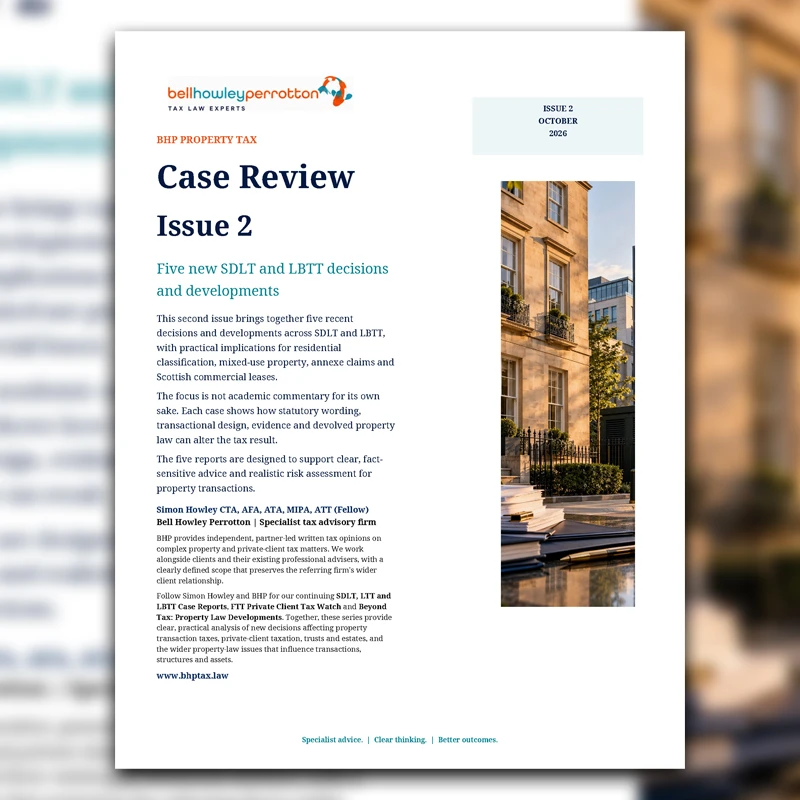
I am pleased to share the second Issue 2 our BHP Property Tax Case Review, continuing our examination of significant decisions affecting Stamp Duty Land Tax (SDLT), Land and Buildings Transaction Tax (LBTT) and Land Transaction Tax (LTT).
This issue brings together five recent tribunal cases, addressing a range of technical and practical questions that continue to arise in property transactions and tax compliance.
The cases considered include:
Although the cases concern different provisions and factual circumstances, they reinforce a familiar theme: property transaction tax liabilities depend on the precise statutory requirements, the facts at the relevant date and the evidence available to support the taxpayer's position.
As with our first issue, we do not simply report tribunal outcomes. We examine the underlying legal questions, the reasoning where available, the limitations of each decision and, importantly, the practical implications for taxpayers and their professional advisers.
We also distinguish between concluded decisions, ongoing proceedings and questions that remain unresolved. That distinction is particularly important where First-tier Tribunal decisions are fact-sensitive or further appeals may follow.
We will continue to follow developments across SDLT, LTT and LBTT, and will publish further issues as significant new decisions emerge.









Bell Howley Perrotton LLP is a limited liability partnership registered in England and Wales under number OC353525. Registered office: 20-22 Wenlock Road, London, N1 7GU. VAT number: GB 991703492.
BHP Advisory Ltd is a company registered in England and Wales under number 15240401. Registered office: 53 Davies Street, Mayfair, London, W1K 5JH. VAT number: GB 484722859.
