
August 4, 2026
Tower One is a reminder that an SDLT appeal can be won on an important statutory point and still be lost overall. The Court of Appeal accepted that the section 54(4) “Case 3” exception applied, but section 75A nevertheless preserved an £8 million assessment. The judgment is a major authority on the breadth of “scheme transactions”, the treatment of an intermediate share sale and the limits of group relief where the wider arrangements had a corporation tax avoidance purpose. The Supreme Court has now granted permission to appeal.
Tower One is the sort of case that punishes anyone who analyses a property restructuring one document at a time. The Court of Appeal accepted that the taxpayer was right on a significant part of the ordinary SDLT code. That success did not alter the outcome, because section 75A of the Finance Act 2003 allowed the court to look across the complete sequence and substitute a notional land transaction.
The result was that an £8 million SDLT assessment survived, even though the taxpayer established that the connected-company market value rule did not apply to the actual transfer in the way HMRC had originally contended. The case is therefore important not simply as another anti-avoidance decision, but as a practical lesson in how statutory fictions, relief restrictions and non-land transactions can interact.
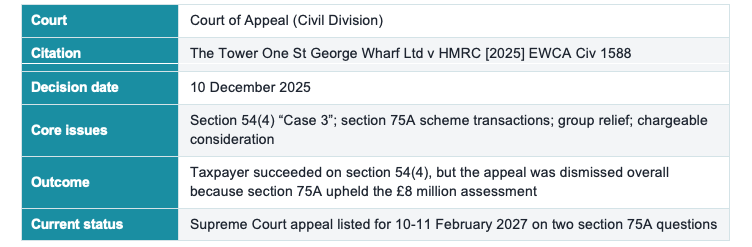
The Berkeley group was developing the 50-storey Tower at St George Wharf in Vauxhall. The Tower had a book cost of approximately £30 million and a market value of approximately £200 million. There were genuine commercial reasons for moving it into a special-purpose vehicle, including ring-fencing development risk and creating the possibility of securitised borrowing.
However, the group did not use a direct transfer. Following advice from PwC, it implemented a series of intra-group steps on 5 July 2011 that was expected to produce a tax-free corporation tax “step-up” from book cost to market value. That corporation tax planning was subsequently accepted to have failed.
· A £1,000 capital contribution was made to Berkeley Sixty-Four Limited (B64), creating positive distributable reserves.
· St George (South London) Limited (SGSL), which held legal title as bare trustee, granted B64 a 999-year lease for a premium of £30,198,814 and nominal rent.
· Tower One acquired the entire issued share capital of B64 for £170,000,001.
· B64 transferred the lease to Tower One for £30,248,814, broadly its carrying value.
Group relief was claimed on the lease grant and the transfer. HMRC denied Tower One’s claim on the basis that the transfer formed part of arrangements of which a main purpose was the avoidance of corporation tax. HMRC assessed Tower One to £8 million of SDLT, being 4% of the lease’s approximate £200 million market value.
Section 53 of the Finance Act 2003 can substitute market value where a company acquires land from a connected person. Section 54 contains exceptions. “Case 3” in section 54(4) applies, broadly, where a corporate vendor distributes an asset, subject to a proviso concerning property that has been the subject of a transaction in respect of which group relief was claimed within the previous three years.
The tribunals below had treated B64’s earlier group relief claim as sufficient to disapply the exception, even though the claim was not valid. The Court of Appeal disagreed. Looking at the purpose of the proviso and its relationship with the group relief clawback rules, the court held that it was directed at group relief that had actually been obtained. An ineffective or invalid claim was not enough.
That was a meaningful taxpayer victory. On the actual B64-to-Tower One transfer, the connected-company market value rule was therefore excluded. The ordinary charge would have been based on the £30,248,814 actually paid, producing SDLT of roughly £1.2 million rather than £8 million.
Yet that was not the end of the case. HMRC had protected its position through a respondent’s notice relying on section 75A.
Section 75A applies where one person disposes of a chargeable interest, another person acquires it or a derived interest, a number of transactions are involved in connection with that disposal and acquisition, and the SDLT payable on those transactions is less than the SDLT payable on a statutory notional transaction directly between the original vendor and the ultimate purchaser.
A crucial point is that section 75A does not contain a motive test. Its heading and purpose are anti-avoidance, but the Supreme Court confirmed in Project Blue that the provision can operate whenever the chosen series produces less SDLT than the statutory comparator, regardless of why the parties transacted as they did. Motive remained relevant in Tower One for the separate group relief restriction, but it was not a precondition to section 75A itself.
The Court of Appeal treated the £170 million share acquisition as a “scheme transaction”. The words “in connection with” were given their naturally broad reach. It did not matter that the lease might, in theory, have been transferred without the share purchase. The question was how the scheme actually implemented had moved the chargeable interest. The share sale was an important component of that plan.
Nor was the share sale “merely incidental” within section 75B. The step plan required it to occur before the lease transfer, and the transfer was in reality conditional on that sequence having been completed. The share sale also served a substantive corporation tax purpose; it was not simply an administrative accompaniment to a direct land transfer.
Section 75C(2) provides that the notional transaction attracts any relief that it would have obtained as an actual transaction, but expressly subject to the terms and restrictions of that relief. Tower One argued that a notional direct transfer into the SPV should therefore qualify for group relief because the underlying decision to ring-fence the Tower was commercial.
The court rejected that approach. The statutory fiction required a notional transaction, but it did not require the wider history and purposes of the real arrangements to be erased. The FTT had found that the steps formed one set of arrangements with a main purpose of avoiding corporation tax. Paragraph 2(4A) of Schedule 7 denies group relief where a transaction forms part of arrangements with a main tax-avoidance purpose, and “tax” for this purpose includes corporation tax. The restriction therefore continued to bite.
The Case 3 exception was also unavailable for the notional grant. SGSL was a bare trustee. The special lease rules treated it as the vendor for SDLT purposes, but the court would not extend that fiction so far as to pretend that SGSL had distributed an asset which, beneficially, it did not own.
The most striking part of the judgment may be the statutory comparison. The aggregate consideration on the actual transactions was calculated at £230,447,628. HMRC’s figure for the notional transaction was £230,448,629, comprising the lease premium, the share consideration, the later lease transfer consideration and the £1,000 capital contribution.
The notional figure was therefore only £1,001 higher. That narrow difference was enough to satisfy section 75A(1)(c). The court held that the share consideration and the amounts received by the vendor or connected parties had to be aggregated. HMRC did not seek to increase the existing assessment above the £8 million calculated on the £200 million market value, but the reasoning illustrates how unforgiving the statutory machinery can be.

· Map every transaction, payment, undertaking and corporate step, not merely the conveyance or lease transfer.
· Test section 75A by reference to the arrangement actually implemented, rather than a hypothetical simpler route that was not used.
· Analyse the restrictions on a relief independently from the basic qualifying conditions.
· Remember that a main purpose of avoiding another tax, including corporation tax, may deny SDLT group relief.
· Do not assume that a statutory fiction removes inconvenient facts; the fiction extends only as far as its statutory purpose requires.
· Model the section 75A consideration arithmetically. Small differences can determine whether the section is engaged.
The Supreme Court has granted Tower One permission to appeal. The official case summary identifies two issues: whether the Court of Appeal was wrong to treat the share transfer as a scheme transaction for section 75A purposes, and whether it was wrong to conclude that the notional transaction did not attract group relief. The hearing is currently listed for 10 and 11 February 2027.
Those questions go to the heart of the Court of Appeal’s section 75A reasoning. Until the Supreme Court rules, however, the Court of Appeal judgment remains the operative appellate authority.
Tower One is not simply a warning that section 75A is broad. It is a warning against fragmenting the analysis. The taxpayer succeeded on the ordinary market value provisions, but the wider statutory architecture still produced the same substantial liability.
In my view, the enduring lesson is that SDLT is not determined only by where the property starts and ends. It can depend on every step used to move it, every payment connected with that movement and every restriction attached to the reliefs relied upon. Advisers who focus only on the destination risk missing how the legislation taxes the journey.









Bell Howley Perrotton LLP is a limited liability partnership registered in England and Wales under number OC353525. Registered office: 20-22 Wenlock Road, London, N1 7GU. VAT number: GB 991703492.
BHP Advisory Ltd is a company registered in England and Wales under number 15240401. Registered office: 53 Davies Street, Mayfair, London, W1K 5JH. VAT number: GB 484722859.
