
August 24, 2026

A permission-to-appeal decision with important lessons on commerciality, entity-specific evidence and trade commencement.
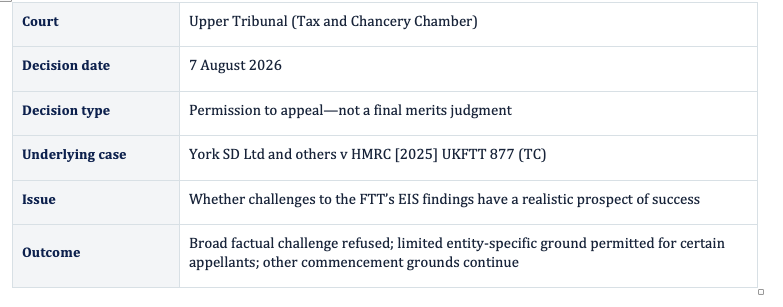
Permission-to-appeal decisions do not finally determine the taxpayer’s liability. Their function is to decide whether a proposed ground of appeal is arguable and has a realistic prospect of success.
They can nevertheless be revealing. They identify which aspects of the First-tier Tribunal’s reasoning are vulnerable, which factual findings are likely to remain undisturbed and which legal questions the Upper Tribunal considers worthy of a full hearing.
York SD is therefore best read as a map of the forthcoming EIS appeal—not as a reversal of HMRC’s withdrawal of relief.
The case concerns six UK companies established to pursue solar electricity projects. Investors subscribed for EIS shares between December 2015 and March 2016. The intended larger projects were ground-mounted solar developments in Spain and Portugal, undertaken through local subsidiaries.
Those overseas projects did not begin operating until 2018 or later. In the meantime, each UK company carried out a small rooftop solar installation in the United Kingdom and entered into arrangements to sell the electricity generated.
The installations were intended, at least in part, to demonstrate that the companies had commenced qualifying business activity within the EIS timetable. HMRC initially authorised compliance certificates, but later withdrew relief on the basis that the statutory requirements had not been met.
The First-tier Tribunal dismissed the companies’ appeals. It concluded, among other things, that the rooftop activity was not commercially viable and was not carried on with a genuine view to profit. It also rejected arguments based on a deemed group trade, waiver and estoppel.
EIS relief is subject to detailed timing conditions. A company must begin the relevant qualifying trade or qualifying business activity within the statutory period and must continue to satisfy the requirements for the minimum period.
The commencement question is not answered merely by identifying the first physical act undertaken by the company. The act must form part of the carrying on of the relevant trade or business activity. Preparatory work, a demonstration project or a transaction undertaken principally to trigger a statutory date may not be enough if it lacks genuine commercial substance.
That does not mean that a trade must already be profitable or fully developed. Start-up activity is often small and loss-making. The question is whether the activity is genuinely directed at the commercial trade that the company says it has begun.
The FTT examined the rooftop installations, their economics, the companies’ wider plans and the relationship between the UK activity and the later Iberian projects.
It found that the rooftop installations did not represent commercially viable trades carried on with a view to profit. The scale and structure of the activity supported the conclusion that its principal function was to establish a commencement date for EIS purposes rather than to operate a genuine stand-alone solar business.
The FTT also considered each of the wider statutory requirements. The existence of HMRC-authorised compliance certificates did not prevent HMRC from withdrawing relief when later information showed that the conditions were not met.
The companies sought to challenge the FTT on several grounds. One was a broad Edwards v Bairstow challenge: in substance, an argument that the FTT’s factual conclusions were irrational or unsupported by the evidence.
The Upper Tribunal refused permission on that broad ground. Evaluative findings about commerciality, profit purpose and the nature of the activity are primarily for the FTT. An appeal court will not revisit them merely because another tribunal might have weighed the evidence differently.
The UT did, however, allow a limited additional ground for the appellants other than York SD. It was arguable that the FTT had not sufficiently addressed the distinct factual position of each company rather than treating the group too collectively.
Other grounds concerning the legal test for commencement were already proceeding. Those grounds will be considered against the developing authority, including the Upper Tribunal’s decision in Putney Power.
The result is therefore mixed: the core factual findings remain a significant obstacle, but certain legal and entity-specific arguments will receive a substantive hearing.
The entity-specific ground is particularly important in group investment structures. EIS relief is claimed by reference to shares in a particular issuing company. Even where several companies are managed together, follow the same business plan and use the same advisers, the statutory conditions must be applied to each company.
Evidence should therefore identify, for every issuing company:
· the activity it actually carried on;
· the date on which that activity began;
· the contracts, assets, personnel and decision-making attributable to it;
· the commercial model and forecast by which it expected to make profit;
· the relationship between any preliminary activity and the intended main trade; and
· the use made of the EIS subscription proceeds.
A group-level narrative may be commercially convenient, but it can obscure differences that become decisive in a statutory appeal.
The case should not be reduced to the proposition that small activity can never amount to a trade. Many genuine start-ups begin with a pilot, a single customer or a modest initial asset.
The difficulty arises where the activity appears to have been selected primarily because it is quick and inexpensive to implement, while the actual commercial project remains remote, separately located or dependent upon later development.
The stronger the tax-timing motivation, the more important it becomes to demonstrate that the initial activity made commercial sense on its own terms or formed a genuine first phase of the intended trade. Business plans, contemporaneous forecasts, board papers, customer arrangements and operational records are likely to be more persuasive than labels applied after the event.
The underlying FTT decision also illustrates a recurring misconception. HMRC’s authorisation of an EIS compliance certificate enables the company to issue certificates to investors, but it is not an irrevocable ruling that every statutory condition has been and will remain satisfied.
The legislation permits relief to be withdrawn where later information or events demonstrate non-compliance. Companies and promoters should therefore continue monitoring the conditions after authorisation and should ensure that investor communications do not overstate the protection offered by the certificate.
· Treat each EIS company as a separate evidential case, even where companies form part of a common programme.
· Document why the earliest activity was commercially undertaken and how it connected with the intended trade.
· Prepare realistic forecasts showing a genuine view to profit; do not rely solely on the fact that revenue was technically possible.
· Avoid creating a commencement step that exists only to satisfy a statutory date without operational substance.
· Track the use of EIS funds and the progress of subsidiaries or overseas projects against the statutory timetable.
· Explain to investors that compliance certificates do not prevent later withdrawal of relief.
· Monitor the substantive Upper Tribunal appeal before treating York SD as settled authority on the commencement test.
York SD has not yet produced a final Upper Tribunal answer. The permission decision leaves the FTT’s adverse findings in place while allowing selected legal and entity-specific issues to proceed.
Its immediate lesson is evidential. EIS planning cannot safely rely on a generic group narrative or a minimal act designed to start the clock. Each issuing company needs contemporaneous evidence that it genuinely commenced the relevant commercial activity with a view to profit.
The substantive appeal will be important for the precise legal test. Until then, advisers should treat the case as a warning that commencement is proved by commercial reality—not by the earliest event that can be described as trading.










Bell Howley Perrotton LLP is a limited liability partnership registered in England and Wales under number OC353525. Registered office: 20-22 Wenlock Road, London, N1 7GU. VAT number: GB 991703492.
BHP Advisory Ltd is a company registered in England and Wales under number 15240401. Registered office: 53 Davies Street, Mayfair, London, W1K 5JH. VAT number: GB 484722859.
