
June 25, 2025
Solicitors
I have been reading this month that the SRA are considering reforming the roles of the COLP, COFA and MLRO to make it mandatory to have a set term that any one person can serve in the role and a ban on management holding all compliance positions.
Over 2400 firms have the same person acting in all three roles and whilst Axiom Ince is an extreme example, the case highlights the risks of having all your compliance eggs in one basket; as it turned out a £66 million risk.
So why is this relevant to calculating SDLT?
Well, a recent Thirdfort report found that only 15% of compliance officer felt their role was taken seriously within their firm and yet 49% also reported that AML compliance as one strand of their role, negatively impacts their wellbeing on a weekly basis.
There is a disconnect here that needs to change.
The calculation of SDLT becomes ever more complex as the annual budgets introduce and then remove reliefs, define the same elements differently according to whether it applies to a surcharge or a relief and property lawyers rely heavily on clients to provide complete information in order to draft up an SDLT1.
Do you just rely on the fact that this is a self assessed tax and ultimately it is your clients responsibility to get it right? Is your client doing the same or is there an expectation from them that you will fulfil the role of tax adviser? Are you trying to understand the case examples in the HMRC Guidance manuals and how the relate to your matter, and by doing so are you fulfilling the role of tax adviser without running it passed your Compliance team?
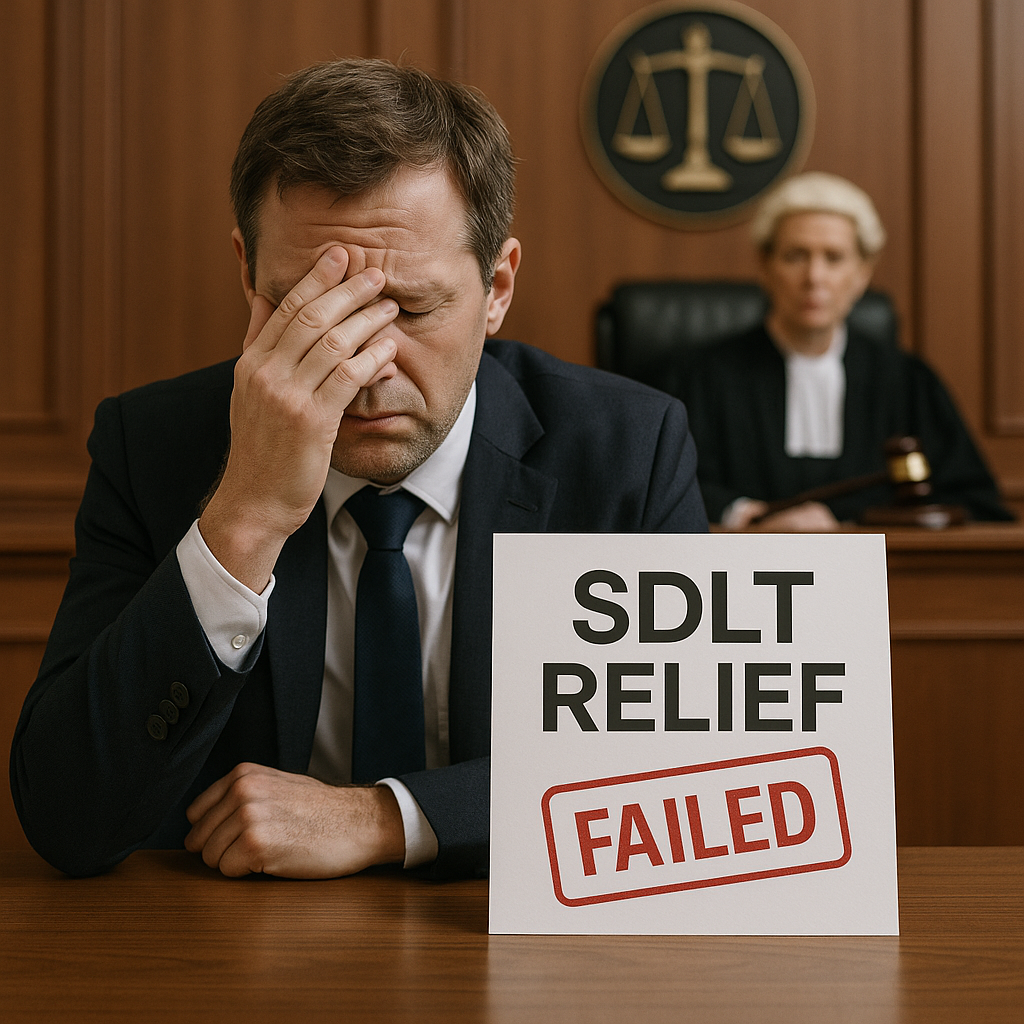
The recent appeal to the UTT from the FTT of L-L-O Contracting Limited and Others v HMRC (2025) is a case where the appellants sought to retrospectively claim MDR, despite the lapse of the 12 month window in which a taxpayer has the chance to amend the SDLT1.
The appellants had all paid SDLT and subsequently sought to claim MDR under S. 58D(2) Finance Act 2003. Under that section MDR ‘must be claimed in a land transaction return or in an amendment to such a return’ and Sch 10 para 6(3) provides that the time limit for such a claim is 12 months from the date of the SDLT return.
Each of the Appellants did not make their MDR claims in their SDLT returns or by amendment to those returns and instead submitted free-standing claims under Sch 10 para 34. However, Sch 10 para 34A sets out a number of cases when HMRC is not liable to give effect to an overpayment claim. Case A includes those where the overpayment results from ‘a mistake consisting of failing to make …..a claim.’
HMRC refused the Appellants overpayment claims on the basis they had each made a mistake by failing to claim MDR in the SDLT returns or by amendments to those returns within the statutory twelve month period, against which the Appellants appealed.
Schedule 10 para 34 allows a claim to be made if a person has ‘paid an amount by way of tax but believes that the tax was not due’. Therefore, all that is required to make a claim under para 34 is that the person believes SDLT has been overpaid.
The court found that where a person has failed to claim MDR in accordance with s58D(2), an SDLT overpayment can arise for the purposes of a claim for overpayment relief under para 34.
So far so good.
But, despite the Appellants counsels attempts to demonstrate that a mistake can only be made where the Appellants were consciously aware that the relief was available, the courts relied on the dictionary definitions that a mistake can include an unwanted result or something badly selected, thereby referring to the outcome rather than importing a prior awareness before making the decision.
The court agreed with HMRC that merely meeting the conditions for the relief is not enough to secure that the taxpayer actually receives the relief. The relief requires a claim, and if the claim is not made then the tax payer will not get it. Similarly, any amendment must be made within the statutory period of 12 months, and so the Appellants lost again. HMRC v Candy 2021 UKUT 170.
As always, these cases highlight the importance of ensuring that your clients receive expert advice prior to completion of their purchase, to ensure that the correct amount of SDLT is reported on the SDLT1, and paid by the client, thereby removing the need to make any application for amendment to the return.
By giving the tax advice to the client for which we are fully qualified and insured, we remove any risk to you of a mistake being made that cannot be addressed without recourse to your PI and your compliance officer can sleep easy.
Links are here to download SDLT Solicitors guide and Clients guide and as always if you have anything on your desk that should be on our desk, then please get in touch.
I look forward to hearing from you.











Bell Howley Perrotton LLP is a limited liability partnership registered in England and Wales under number OC353525. Registered office: 20-22 Wenlock Road, London, N1 7GU. VAT number: GB 991703492.
BHP Advisory Ltd is a company registered in England and Wales under number 15240401. Registered office: 53 Davies Street, Mayfair, London, W1K 5JH. VAT number: GB 484722859.
