
September 25, 2026
Solicitors
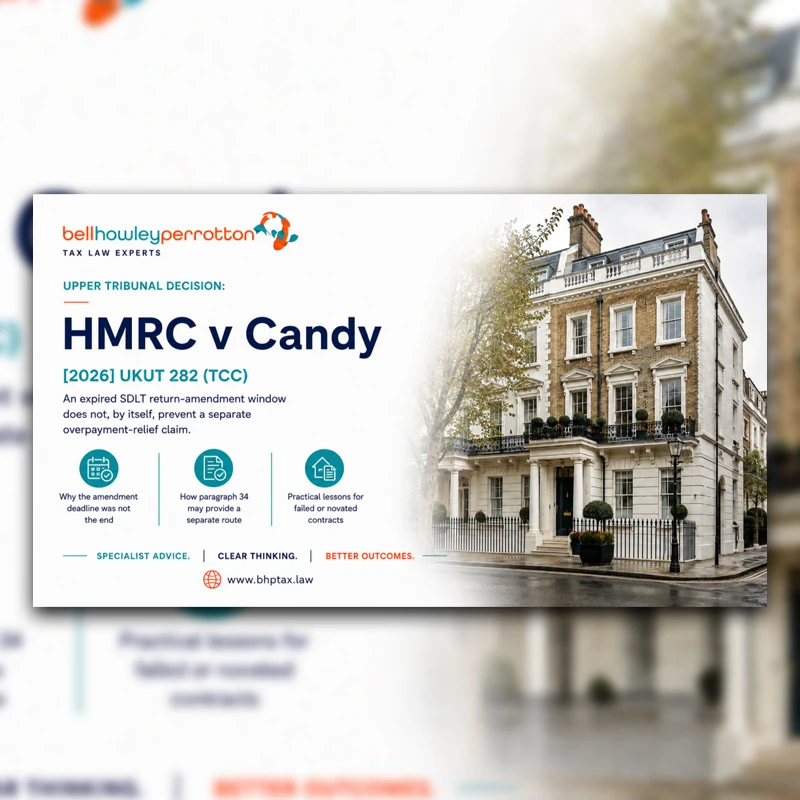
The Upper Tribunal has handed taxpayers an important victory in Commissioners for HMRC v Christian Peter Candy [2026] UKUT 282 (TCC), confirming that SDLT overpayment relief may remain available even where the normal time limit for amending the SDLT return has expired.
Christian Candy had paid £1.92 million of SDLT following substantial performance of a contract relating to Gordon House in Chelsea, now known as Providence House.
The contract was subsequently novated to his brother, Nicholas Candy. As a result, Christian Candy's original contract was not ultimately carried into effect, while Nicholas Candy became liable to SDLT following substantial performance of the novated agreement.
Ordinarily, section 44(9) Finance Act 2003 allows SDLT paid following substantial performance to be repaid where the contract is subsequently rescinded, annulled or otherwise not carried into effect.
The contract was novated after the normal 12-month period for amending the SDLT return had expired. Earlier litigation had established that Mr Candy could not use section 44(9) to circumvent that statutory amendment deadline.
He therefore relied upon the separate overpayment relief provisions in paragraph 34, Schedule 10 Finance Act 2003.
HMRC argued that section 44(9) provided the exclusive route to repayment and that, once the amendment deadline had passed, paragraph 34 could not be used instead.
The Upper Tribunal disagreed.
The UT confirmed that overpayment relief is a separate remedy, with its own procedure, statutory conditions and time limit.
The requirement in section 44(9) that repayment be claimed by amending the land transaction return governs a claim made under section 44(9). It does not, by itself, prevent a taxpayer from making a distinct claim for overpayment relief under paragraph 34.
Importantly, an overpayment relief claim currently has its own four-year time limit from the effective date of the transaction, subject to the exclusions and restrictions contained in paragraph 34A. The UT described overpayment relief as ordinarily being a remedy of “last resort” rather than simply an extended amendment window.
HMRC's appeal was therefore dismissed.
The decision is important beyond the unusual facts of the Candy litigation.
It confirms that the expiry of the SDLT return amendment period does not necessarily bring the matter to an end. Where SDLT has genuinely become overpaid and the normal statutory mechanism for correcting the return is no longer available, paragraph 34 should be considered separately.
That does not mean that every late SDLT claim can be converted into an overpayment relief claim. Paragraphs 34 and 34A contain important conditions and exclusions, and each claim will remain highly fact-sensitive.
But the wider principle is significant: a procedural time limit applying to one statutory repayment route does not, without more, extinguish a separate statutory right to overpayment relief.
In the particular circumstances of Candy, that prevents the striking result of SDLT remaining charged on Christian Candy following substantial performance of a contract which was never carried into effect, while a further SDLT liability arose when the same underlying property transaction moved to his brother.
Key point: Where the usual SDLT amendment window has closed, advisers should not automatically assume that repayment is impossible. The separate overpayment relief regime in paragraph 34, Schedule 10 FA 2003 should always be considered.











Bell Howley Perrotton LLP is a limited liability partnership registered in England and Wales under number OC353525. Registered office: 20-22 Wenlock Road, London, N1 7GU. VAT number: GB 991703492.
BHP Advisory Ltd is a company registered in England and Wales under number 15240401. Registered office: 53 Davies Street, Mayfair, London, W1K 5JH. VAT number: GB 484722859.
